Products being added to this category.
Enquire directly →What is a Hydrogen Flame Detector?
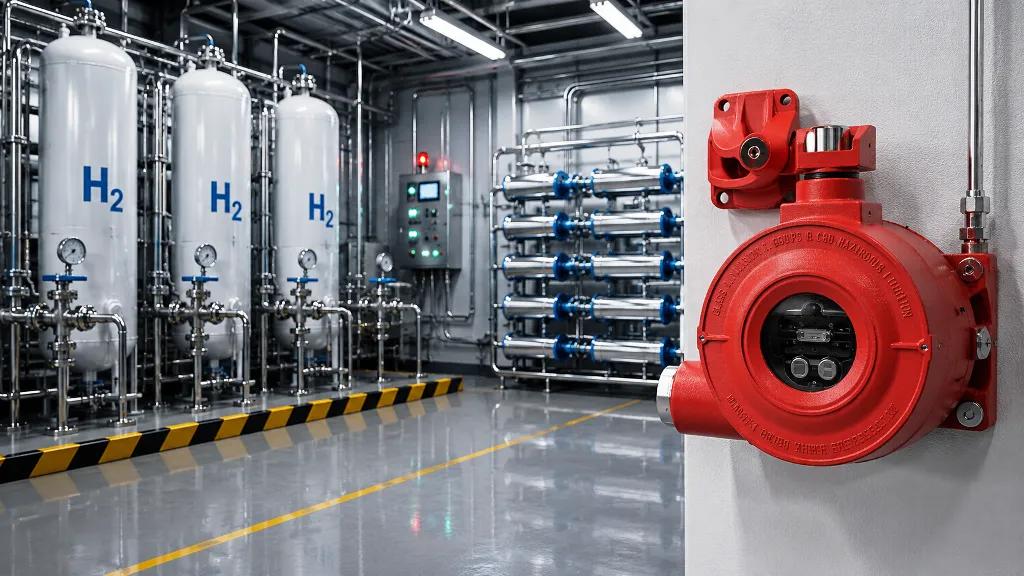
A hydrogen flame detector identifies the presence of an active flame using optical sensing technology — critically important for hydrogen safety because hydrogen flames burn with little to no visible light and produce minimal smoke, making them essentially invisible to the naked eye in daylight conditions. Where gas detectors identify hydrogen before ignition, flame detectors confirm that ignition has already occurred — triggering immediate emergency response.
Hydrogen flames emit strongly in the ultraviolet (UV) spectrum, which forms the basis of most hydrogen flame detection technology. UV detectors respond rapidly to the characteristic UV radiation signature of a hydrogen flame, typically achieving detection within milliseconds of ignition. Combined UV/IR detectors add infrared sensing to improve false alarm rejection — distinguishing genuine flames from other UV sources such as welding arcs, lightning or sunlight reflection.
Flame detectors are positioned with direct line-of-sight to potential ignition points — typically at hydrogen dispensing nozzles, compression equipment, valve manifolds and process connections where a leak is most likely to occur and ignite. Detection triggers immediate response: automatic shutoff of hydrogen supply, activation of suppression systems, and alarm notification. Flame detectors are a critical layer in hydrogen safety systems, operating alongside gas detectors to provide comprehensive protection across the full leak-to-ignition timeline. Hydrogenergy supplies UV and UV/IR flame detectors for hydrogen fuelling stations, process facilities and industrial hydrogen installations.