H₂ Products

All Products
Electrolyzers
Fuel Cells
H₂ Leak Detectors
Dew Point Meters
Hydrogen Purity Analyzers
Mass Flow Controllers
Digital Pressure Gauges
MEA & Materials

Can't find what you need? We source custom components.

Custom Request →
Digital Pressure Gauges
H₂ Products · Digital Pressure Gauges

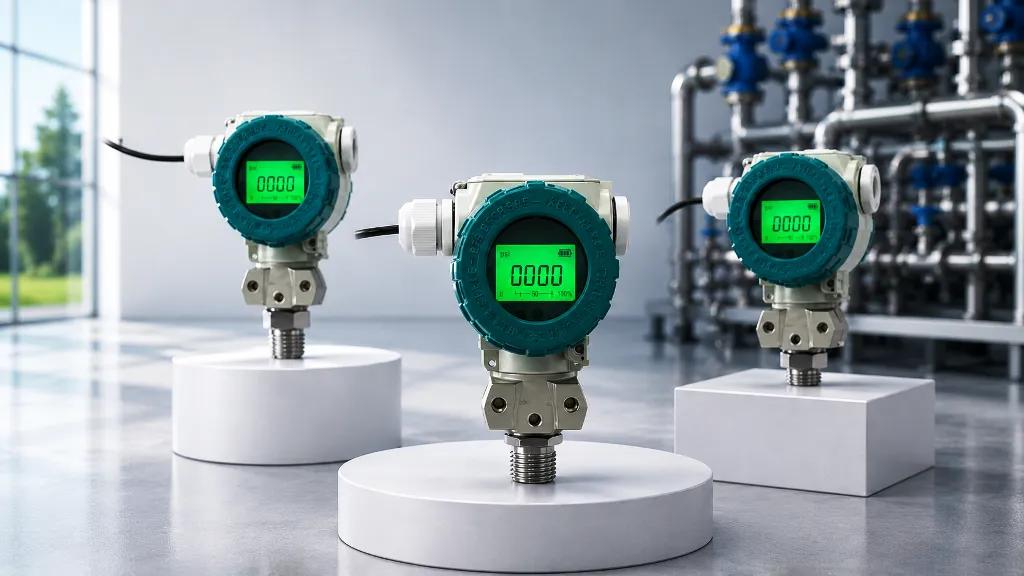
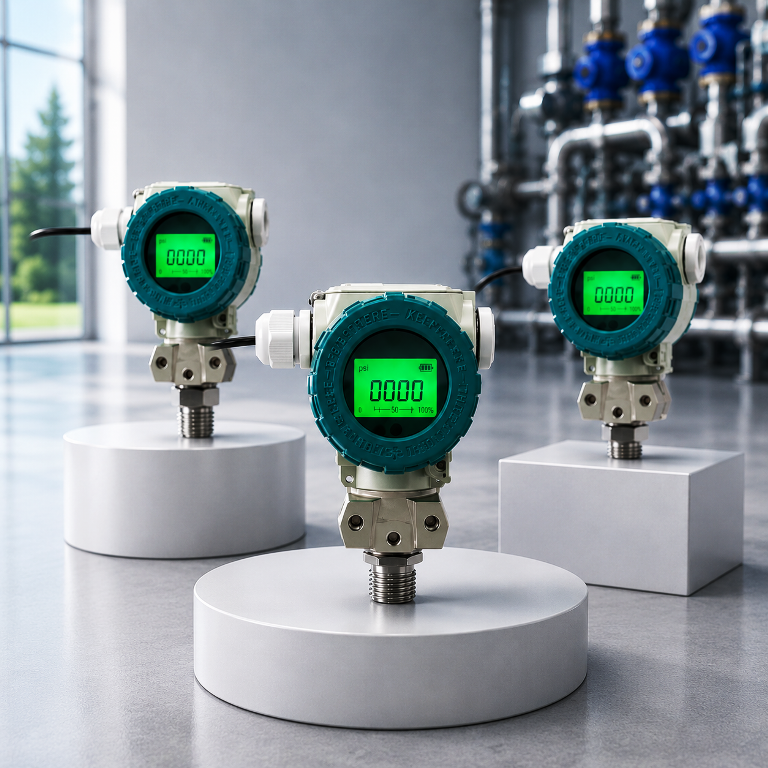
Digital Pressure Gauges & Transmitters

Panel Mount · Inline · Differential · Transmitter

Precision hydrogen pressure measurement for test stations, storage systems, compression stages, pipework and process installations. Digital pressure gauges and transmitters for point measurement, system monitoring and process control integration — across a wide range of pressure ranges and connection standards.

What is a Digital Pressure Gauge?

Accurate pressure. Reliable systems.

A digital pressure gauge is an instrument that measures and displays gas or fluid pressure at a defined point in a system — with higher accuracy, better readability and additional output options compared to traditional mechanical gauges. In hydrogen systems, where operating pressures range from near-atmospheric at electrolyzer outlets to several hundred bar at high-pressure storage cylinders, accurate pressure measurement at each stage is essential for safe, controlled and efficient operation.

Digital pressure gauges use a piezoresistive, capacitive or strain-gauge sensing element to convert pressure into an electrical signal, which is processed and displayed as a numeric readout in the selected engineering unit — bar, psi, kPa, MPa or mbar depending on the application. Unlike mechanical gauges, digital instruments offer selectable units, peak hold functions, tare zeroing, and in transmitter variants, an analogue or digital output for integration into control and data acquisition systems.

Pressure measurement points in a hydrogen system include the electrolyzer outlet, dryer and purifier stages, compression inlet and outlet, high-pressure storage manifold, regulator outlet, and the delivery line upstream of the end-use equipment. At each point, the gauge must be rated for the operating pressure range, compatible with hydrogen gas, and suitable for the installation environment. Hydrogenergy supplies digital pressure gauges and transmitters across panel-mount, inline and differential configurations for the full pressure range of hydrogen system applications

Which digital pressure gaug is right for you?

Local pressure readout at a single measurement point on a hydrogen system
Panel Mount Digital Pressure Gauge — clear numeric display, selectable units, direct process connection
Pressure measurement with analogue output for integration into a control or data acquisition system
Pressure Transmitter — 4–20mA or 0–10V output, loop-powered, suitable for PLC and DAQ integration
Measurement of pressure difference across a filter, membrane or flow restriction
Differential Pressure Gauge — measures the pressure drop between two points, useful for filter condition monitoring
High-pressure measurement at compression or storage stages up to 300 bar or above
High-Pressure Digital Gauge — rated for elevated pressure ranges, appropriate wetted materials for hydrogen compatibility
Pressure monitoring at multiple points with centralised data logging
Pressure Transmitter with digital output — Modbus or similar protocol for multi-point networked monitoring
Intrinsically safe or ATEX-rated pressure measurement in hazardous areas
Certified Pressure Transmitter — confirm zone classification and certification requirements before specifying

Frequently asked questions

What pressure ranges are available for hydrogen system applications?
Hydrogen systems operate across a very wide pressure range — from near-atmospheric at electrolyzer and fuel cell outlets, through intermediate pressures at dryer and purifier stages (typically 5–30 bar), to high pressures at compression and storage (200–700 bar for vehicle-grade storage). Digital pressure gauges and transmitters are available across this full range, but each instrument must be selected for the specific pressure range of its measurement point. Never install a gauge rated below the maximum system pressure at that point.
Are standard pressure gauges compatible with hydrogen gas?
Not always. Hydrogen's small molecular size and high diffusivity mean that materials compatible with other gases may not be suitable for hydrogen service. Wetted parts — the sensing element, process connection, seals and any internal components in contact with the gas — must be verified as hydrogen-compatible. Brass and certain elastomers commonly used in standard gauges may be unsuitable. Always specify hydrogen-compatible wetted materials and confirm with your supplier before installation.
What is the difference between a pressure gauge and a pressure transmitter?
A pressure gauge provides a local display of pressure at the measurement point — it shows the reading on a built-in screen but does not output a signal to external systems. A pressure transmitter converts the pressure measurement into an electrical signal — typically 4–20mA or a digital protocol — that can be read by a PLC, data acquisition system, or control panel at a remote location. Many modern instruments combine both functions: a display for local reading and an output for system integration.
What is a differential pressure gauge and where is it used in hydrogen systems?
A differential pressure gauge measures the pressure difference between two points in a system rather than absolute or gauge pressure at a single point. In hydrogen systems, differential pressure measurement is used to monitor the condition of inline filters and coalescers — as a filter loads with contaminants, the pressure drop across it increases, indicating when replacement is due. It is also used across membrane purifiers, heat exchangers and flow restrictors where pressure drop is a process parameter.
What output signals are available on digital pressure transmitters?
The most common analogue output is 4–20mA — a two-wire loop-powered signal that is robust over long cable runs and widely supported by PLCs and data acquisition systems. Voltage outputs (0–5V, 0–10V, 1–5V) are also available for shorter-distance connections to bench instruments and test stations. Digital outputs including Modbus RTU over RS-485 are available for multi-drop installations where multiple transmitters share a single communications cable. Confirm the required interface with your control system before specifying.
Need help choosing?
Our engineers will recommend the right digital pressure gauges for your application.
Talk to an Engineer →