Test Station Models
165W precision testing with EIS capability.
View station →400W testing for short stacks and large active area cells.
View station →Understanding Test Stations
What is a Fuel Cell Test Station?
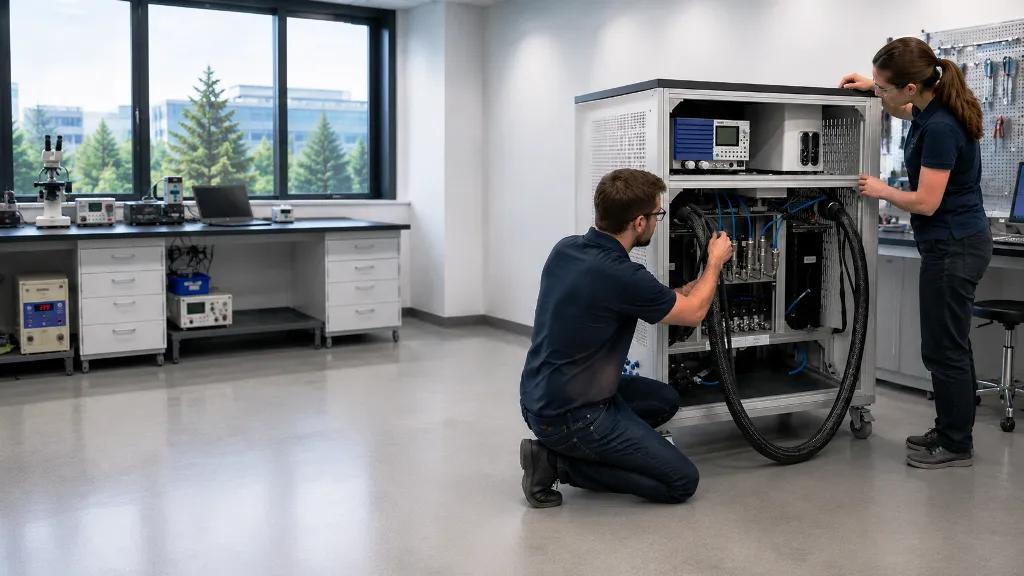
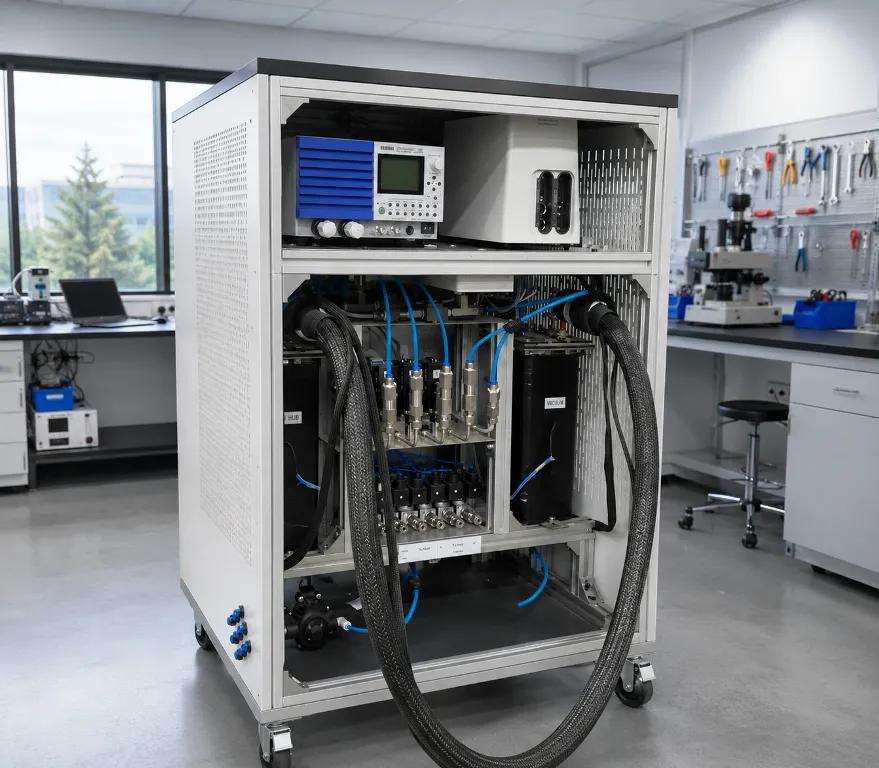
A fuel cell test station is a precision instrument platform designed to characterize, validate and optimize PEM fuel cell stacks and single cells. It controls the key operating parameters — reactant flow rates, temperature, humidity and pressure — while measuring voltage, current and impedance.
What is an Electrolyzer Test Station?
An electrolyzer test station provides controlled current or voltage to a PEM or alkaline electrolyzer stack while measuring performance metrics such as hydrogen production rate, cell voltage, power consumption and efficiency. It allows researchers to characterize electrolysis performance across a range of operating conditions.
Why choose Hydrogenergy test stations?
Built for Indian labs
Systems configured for 230V/50Hz operation, shipped from India with full commissioning support.
EIS capability standard
Electrochemical impedance spectroscopy included — no expensive add-on modules required.
Complete data acquisition
Built-in DAQ, safety interlocks and control software delivered ready to run.
Direct engineering support
Speak to the same engineers who built your system — not a call centre.
How test stations work
Set operating conditions
Define flow rates, temperature, humidity and pressure setpoints via the control interface.
Run the test protocol
The station controls and logs all parameters automatically — polarization curves, EIS sweeps or custom profiles.
Acquire & analyse data
Real-time data is logged and exportable for analysis in Excel, MATLAB or Python.
Iterate & validate
Adjust MEA composition, operating conditions or stack design — repeat until performance targets are met.