Quick Definition
Hydrogen storage is the practice of retaining hydrogen in a stable and secure form so it can be transported, stored, and supplied whenever energy is required. The storage method influences how much hydrogen can be stored, how easily it can be handled, the overall system cost, and its suitability for applications ranging from research laboratories to large-scale industrial and mobility systems.
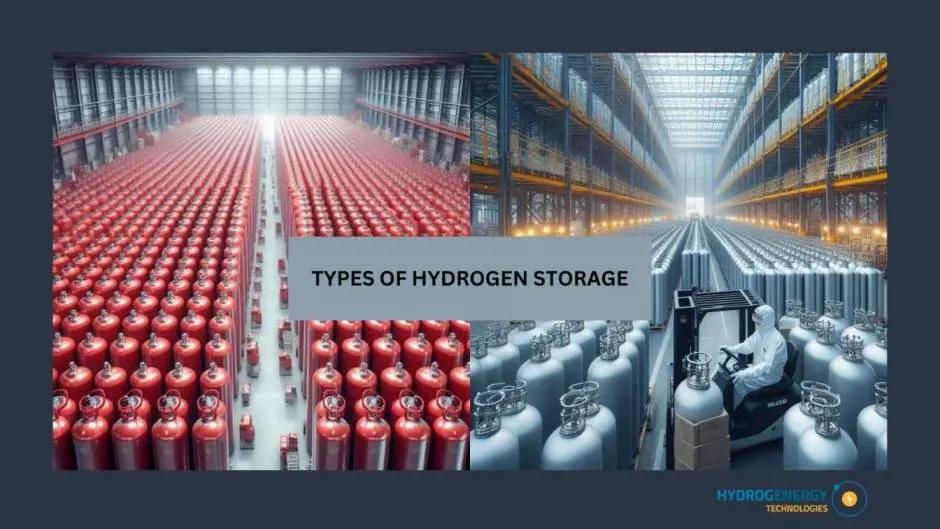
As the hydrogen economy continues to gain momentum, one of the most critical considerations is how to store hydrogen efficiently and safely. Hydrogen storage solutions vary based on the intended application, energy density requirements, cost considerations, and safety standards. Whether you are an industry professional, a researcher, or a business looking to integrate hydrogen storage, understanding the available technologies will help determine the best solution for your needs.
Types of Hydrogen Storage Solutions
Hydrogen storage technologies can generally be categorized into three main types: Compressed Gas Storage, Liquid Hydrogen Storage, and Solid-State Hydrogen Storage.
1. Compressed Gas Storage
Compressed gas storage is the most widely used hydrogen storage method today. Hydrogen gas is stored at high pressures, typically 350 to 700 bar, in specialized tanks made from materials like steel, aluminum, or carbon fiber composites. For a closer look at how these tank designs actually differ, our guide to types of compressed hydrogen storage breaks down Type 1 through Type 5 construction in detail.
Technical details: hydrogen molecules are compressed using multi-stage compressors. Storage tanks are typically Type I (metal), Type II (metal liner with composite wrap), Type III (composite with metal liner), or Type IV (full composite). Advanced carbon fiber reinforced polymer (CFRP) tanks provide a balance of strength and weight reduction. Leak prevention is ensured through high-integrity seals and pressure relief valves.
Pros: readily available and commercially proven technology. Suitable for applications requiring fast refueling, such as fuel cell vehicles. Scalable for small to large-scale storage.
Cons: requires high-pressure containment, which can be expensive. Energy-intensive compression process, using roughly 15 percent of the stored hydrogen's energy content for compression. Larger storage volume required compared to liquid or solid-state storage.
Best for: hydrogen fueling stations, industrial applications, and portable hydrogen storage solutions.
2. Liquid Hydrogen Storage
Liquid hydrogen storage involves cooling hydrogen to cryogenic temperatures (-253°C) to convert it into a liquid. This significantly reduces the storage volume compared to compressed gas.
Technical details: hydrogen liquefaction involves Joule-Thomson expansion and cryogenic cooling cycles. Liquid hydrogen is stored in double-walled vacuum-insulated cryogenic tanks to minimize heat transfer. Boil-off gases are managed using vapor recovery systems to prevent hydrogen loss.
Pros: higher energy density than compressed gas storage. More efficient for long-distance hydrogen transportation. Commonly used in space applications and large-scale hydrogen distribution networks.
Cons: high energy consumption for liquefaction, typically 30 to 40 percent of the stored hydrogen's energy content. Requires highly insulated cryogenic tanks. Hydrogen boil-off losses occur over time, typically 1 to 3 percent per day depending on insulation quality and tank size.
Best for: long-distance hydrogen transportation, aerospace and space exploration applications, and large-scale hydrogen storage hubs.
3. Solid-State Hydrogen Storage
Solid-state hydrogen storage involves materials that absorb and release hydrogen, such as metal hydrides, borohydrides, chemical hydrides, and porous materials like metal-organic frameworks (MOFs). Our deeper look at metal hydride storage covers this specific approach in more detail.
Technical details: metal hydrides (MH) store hydrogen by forming reversible metal-hydrogen bonds. Examples include LaNi5H6 and TiFe-based alloys, which typically operate closer to room temperature, while higher-temperature hydride materials can require conditions up to around 300°C depending on the specific compound. Borohydrides (BH) and chemical hydrides such as NaBH4 and LiBH4 decompose at higher temperatures, generally above 300°C, offering higher hydrogen capacity, roughly 10 to 18 weight percent. MOFs are high-surface-area materials allowing physisorption of hydrogen at cryogenic conditions. Hydrogen desorption is controlled by heating and pressure adjustments.
Pros: higher volumetric energy density compared to compressed gas storage. Can operate at lower pressures and temperatures, enhancing safety. Suitable for stationary and mobile applications where space is a constraint.
Cons: higher initial material and processing costs. Slower hydrogen uptake and release rates compared to gas and liquid storage. Some materials may degrade over multiple cycles of hydrogen absorption and desorption.
Best for: stationary hydrogen storage (backup power, grid storage, and similar applications), fuel cell-powered vehicles and drones, and advanced hydrogen applications in niche markets.
Comparing the three storage methods
| Method | Typical Energy Penalty | Key Advantage | Key Limitation | Best Fit |
|---|---|---|---|---|
| Compressed Gas | ~15% of energy content | Commercially proven, fast refueling | Large storage volume, high-pressure containment cost | Fueling stations, industrial, portable |
| Liquid Hydrogen | ~30-40% of energy content | Higher energy density, efficient long-distance transport | Boil-off losses, cryogenic insulation cost | Long-distance transport, aerospace, distribution hubs |
| Solid-State | Varies by material | Higher volumetric density, lower-pressure safety | Slower uptake/release, higher material cost | Stationary storage, drones, niche mobile applications |
Factors to Consider When Choosing a Hydrogen Storage Solution
- Application — what is the intended use? (e.g., transportation, grid storage, industrial applications, etc.)
- Storage Duration — how long do you need to store hydrogen? Short-term applications may favor compressed gas, while long-term storage may require liquid or solid-state solutions.
- Infrastructure Availability — what existing hydrogen storage infrastructure is available?
- Safety Requirements — are there stringent safety regulations that need to be met?
- Cost Considerations — what is the budget for installation and operational expenses?
- Energy Efficiency — how much energy will be consumed in storage and retrieval?
Conclusion
Selecting the right hydrogen storage solution depends on the specific requirements of the application. Compressed gas storage is best for quick refueling and widespread industrial use, liquid hydrogen is ideal for transportation and aerospace applications, while solid-state storage offers promising solutions for stationary and mobile hydrogen-powered systems. By evaluating factors such as cost, infrastructure, and efficiency, you can determine the most suitable hydrogen storage method for your needs.
As hydrogen technology advances, innovations in storage solutions will continue to improve, making hydrogen a more viable and sustainable energy carrier across industries.
Need help with your hydrogen project?
Our engineers respond within 24 hours with a recommendation.

Hydrogenergy Applications Engineering Team
Applications Engineering · Hydrogenergy Technologies
Hydrogenergy's applications engineering team designs and supplies hydrogen systems for research labs and industry across India — from components to complete commissioned setups.