Quick Definition
Compressed hydrogen storage is a method of storing hydrogen gas by increasing its pressure and containing it in specially engineered high-pressure cylinders or tanks. Common storage pressures range from 350 to 700 bar, making this the most mature and widely deployed hydrogen storage technology for transportation, industrial applications, and refueling infrastructure.
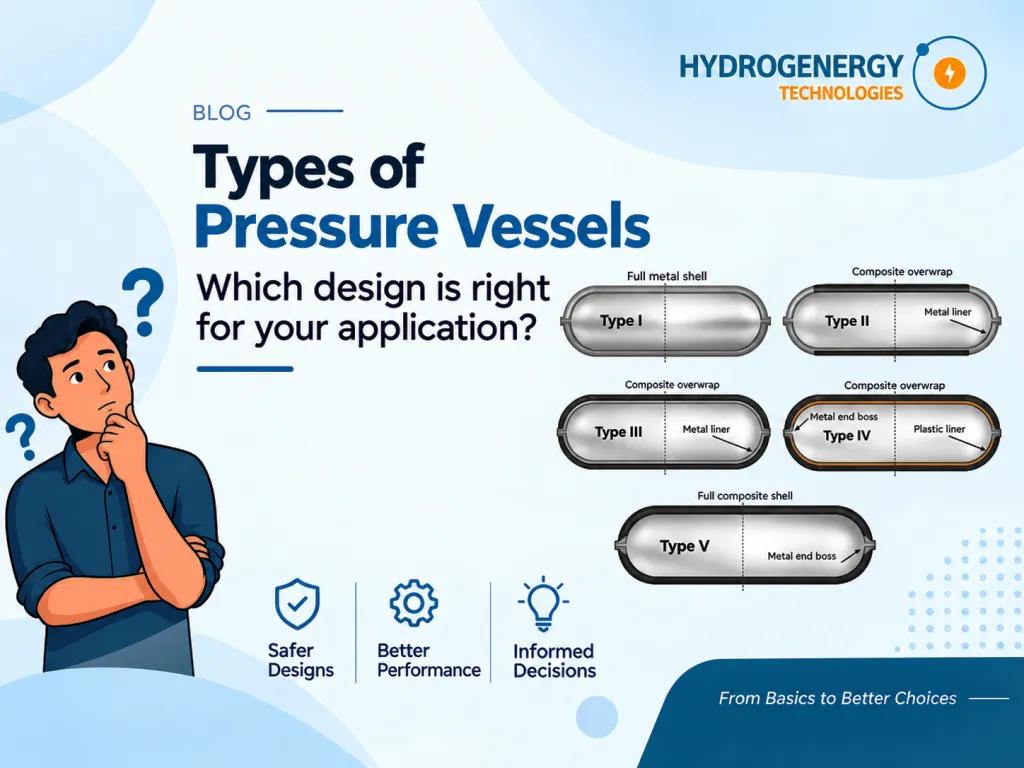
Evolution of Hydrogen Storage from Type-1 to Type-5
Hydrogen storage is crucial for making hydrogen a viable clean energy source. The technology has progressed significantly, leading to five main types of compressed hydrogen storage systems. Each type has its unique features, benefits, and applications. Let's take a closer look at each type and see how they differ.
Type 1: All-Metal Tanks
Type 1 hydrogen tanks are the simplest and most traditional form, constructed entirely from metal, usually steel or aluminum. These tanks are known for their durability and robustness, making them suitable for various industrial applications where they might face extreme conditions.
Type 1 tanks typically handle pressures in the range of 150 to 300 bar, most commonly around 200 bar. Their significant weight is a major drawback compared to composite designs, which limits their use in applications where lighter storage solutions are needed, such as in the automotive or aerospace sectors.
Because of their durability and relatively low cost, Type 1 tanks are often used in stationary applications, such as backup power systems or industrial hydrogen storage. They are less commonly used in mobile applications due to their weight.
Type 2: Metal Liner with Fiber Overwrap
Type 2 tanks incorporate a metal liner hoop-wrapped with a composite fiber, usually fiberglass or carbon fiber. This design maintains the strength and impermeability of the metal while reducing overall weight through the use of composite reinforcement over the cylindrical section of the tank.
Type 2 tanks typically withstand higher pressures than Type 1, with some designs rated up to roughly 260 bar depending on the manufacturer and materials used. The composite overwrap provides a moderate weight reduction compared to all-metal tanks, making them suitable for applications where some weight savings matter without the cost of a full composite wrap.
These tanks are used in applications requiring a balance of durability and weight savings, such as certain transport and industrial settings. They offer a more affordable lightweight option compared to more advanced types.
Type 3: Metal Liner with Full Composite Overwrap
Type 3 tanks feature a full composite overwrap around a metal liner, typically using carbon fiber, rather than the partial hoop-wrap used in Type 2. This structure significantly reduces the tank's weight while the metal liner still contributes to the tank's pressure-bearing strength.
Type 3 tanks are designed to handle higher pressures, commonly up to 700 bar. The full carbon fiber wrap results in substantial weight savings compared to Type 1 tanks, though the tank remains heavier than fully composite designs since it still carries a metal liner.
Type 3 tanks are particularly favored in automotive applications. Their high-pressure capability and reduced weight enhance vehicle efficiency and performance, making them a common choice for fuel cell electric vehicles (FCEVs). They are also used in portable hydrogen storage systems and certain aerospace applications.
Type 4: All-Composite with Polymer Liner
Type 4 tanks mark a significant advancement by utilizing an all-composite structure with a polymer liner instead of a metal one. The polymer liner ensures hydrogen impermeability, while the surrounding carbon fiber composite provides strength and further weight reduction, since the liner itself no longer needs to bear structural load.
These tanks can typically withstand pressures up to 700 bar and, in some advanced designs, higher. Because there's no metal liner at all, Type 4 tanks offer some of the best weight-to-capacity ratios available, commonly cited as up to around 70% lighter than an equivalent Type 1 tank.
Type 4 tanks are extensively used in the automotive industry, particularly in FCEVs, due to their lightweight and high-pressure capabilities. They are also used in portable and stationary hydrogen storage applications where weight and space are critical factors.
Type 5: Linerless All-Composite Tanks
Type 5 tanks represent the newest development in hydrogen storage technology. These tanks eliminate the need for a liner altogether, using advanced composite materials throughout the entire structure. This design pushes weight reduction further and can simplify the manufacturing process, though the technology is still less commercially mature than Type 3 and Type 4 tanks.
Linerless all-composite tanks are designed to handle pressures in the same 700 bar range as Type 3 and Type 4 tanks, with some research designs targeting higher pressures still. The complete reliance on composite materials aims for the lightest possible tank construction available today.
Type 5 tanks sit at the leading edge of hydrogen storage technology, targeted at the most demanding weight-sensitive applications, including next-generation FCEVs and aerospace. Their ultra-lightweight potential also makes them a technology to watch for portable hydrogen storage in emerging applications, though wider commercial deployment is still developing.
Comparing the Five Tank Types
Hydrogen Tank Types at a Glance
| Type | Construction | Typical Max Pressure | Relative Weight | Common Use |
|---|---|---|---|---|
| Type 1 | All-metal (steel or aluminum | 150-300 bar | Heaviest | Stationary, industrial storage |
| Type 2 | Metal liner, hoop-wrapped composite | Up to ~260 bar | Moderately reduced | Transport, industrial |
| Type 3 | Metal liner, fully wrapped composite | Up to 700 bar | Substantially reduced | FCEVs, portable systems |
| Type 4 | Polymer liner, fully wrapped composite | Up to 700 bar | Lightest in wide commercial use | FCEVs, portable and stationary |
| Type 5 | Linerless, all-composite | ~700 bar and higher in development | Lightest overall, still maturing | Next-generation FCEVs, aerospace |
The Future of Hydrogen Storage
As hydrogen technology continues to advance, the development of even more efficient and lightweight storage solutions will be crucial. Innovations in materials science, such as the use of carbon nanotubes and other advanced composites, are expected to further enhance the performance and reduce the cost of hydrogen storage tanks.
Research into alternative hydrogen storage methods, such as solid-state storage and chemical hydrogen storage, could complement or even replace current compressed gas storage technologies for certain applications. These methods have the potential to offer higher volumetric energy densities than compressed gas, alongside different safety and handling profiles worth weighing for a specific use case. For a broader look at how compressed storage compares to these alternatives, see our guide to hydrogen storage technologies.
Conclusion
The progression from Type 1 to Type 5 hydrogen tanks illustrates the significant strides made in hydrogen storage technology. Each type of tank offers unique advantages, from the durability and cost-effectiveness of Type 1 tanks to the ultra-lightweight, high-pressure capabilities of Type 5 tanks. These advancements are pivotal in making hydrogen a viable and efficient energy source for a wide range of applications, from industrial uses to cutting-edge automotive and aerospace technologies.
As the world moves towards cleaner energy solutions, the continued evolution of hydrogen storage will play a crucial role in meeting the growing demand for sustainable and efficient energy. By understanding the different types of hydrogen storage and their specific benefits, we can better appreciate the technological innovations driving the future of clean energy.
Need help with your hydrogen project?
Our engineers respond within 24 hours with a recommendation.

Hydrogenergy Applications Engineering Team
Applications Engineering · Hydrogenergy Technologies
Hydrogenergy's applications engineering team designs and supplies hydrogen systems for research labs and industry across India — from components to complete commissioned setups.