Quick Definition
A hydrogen leak detector is a sensor that identifies the presence of escaped H₂ gas before it reaches a flammable concentration — the three common sensing technologies (catalytic, electrochemical, ultrasonic) trade off sensitivity, response time, and maintenance differently.
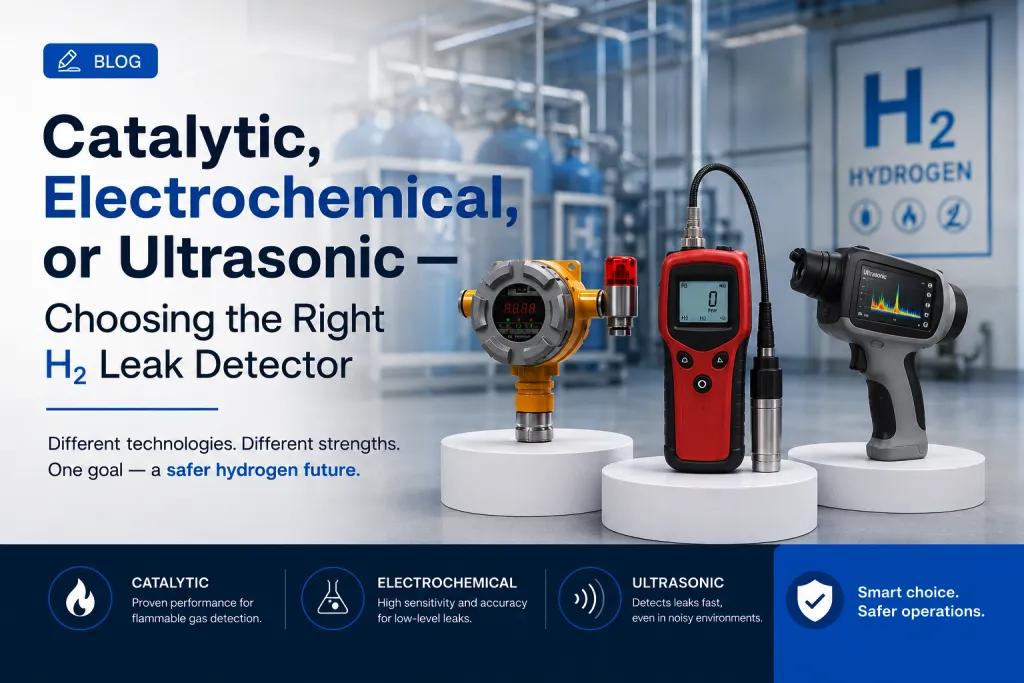
Why hydrogen leaks differently than other gases
Hydrogen is the smallest molecule there is, which means it finds its way through fittings and seals that would hold methane or propane just fine. A connection rated leak-tight for natural gas can still weep hydrogen at a measurable rate — a common surprise for teams moving into H₂ from conventional gas systems.
It's also odorless, colorless, and burns with a flame that's nearly invisible in daylight. None of the senses you'd normally rely on to notice a gas leak work here. That's why hydrogen leak detection leans entirely on instrumentation rather than human perception, and why getting the sensor choice right matters more here than for most other gases.
Three sensing technologies cover most H₂ leak detection: catalytic bead, electrochemical, and ultrasonic. They get lumped together as "leak detectors" in a lot of procurement specs, but each one is physically measuring something different — which is exactly why none of them is a universal answer on its own.
Catalytic bead sensors
A catalytic bead sensor burns the hydrogen at its surface and measures the heat released. Two beads sit in a Wheatstone bridge — one coated with a catalyst that promotes combustion, one inert reference bead — and the resulting temperature difference between them tells you how much H₂ is present in the surrounding air.
This is the oldest and most field-proven approach, and it's still the default for fixed installations in industrial settings: storage rooms, compressor skids, fueling stations, and anywhere a safety auditor expects to see a familiar, well-documented technology. It's robust, relatively inexpensive per point, and well understood by inspectors and insurers who've signed off on catalytic detectors for decades.
The catch is that catalytic sensors need oxygen to support the combustion reaction — they can't function reliably in an inert or oxygen-depleted atmosphere, which matters if you're monitoring inside a nitrogen-purged enclosure. They also drift over time as the catalyst surface ages and need periodic calibration against a known gas concentration, typically every 3–6 months depending on duty cycle. Certain compounds — silicones, sulfur compounds, halogenated solvents — can poison the catalyst and quietly reduce sensitivity without triggering any obvious warning. A poisoned sensor will still report readings; they just won't be trustworthy ones.
Electrochemical sensors
Electrochemical sensors use a chemical reaction at an electrode to generate a current proportional to gas concentration — hydrogen diffuses through a membrane into an electrolyte cell, gets oxidized at the working electrode, and the resulting current is translated into a concentration reading. No combustion involved, which means they work fine in low-oxygen environments where a catalytic sensor would stall.
They're considerably more sensitive at low concentrations — this is the technology you want for early warning at ppm-level leaks, well below the lower flammability limit, rather than waiting until you're already approaching a dangerous concentration. That makes them well suited to enclosed spaces around electrolyzer stacks and fuel cell modules, and any installation where catching a slow leak early matters more than catching a large one fast. A lot of academic lab setups specify electrochemical sensors for this reason — they're monitoring a relatively small, enclosed test rig where the priority is catching a developing problem early, not detecting a catastrophic rupture.
The tradeoff is sensor lifespan. The electrochemical cell is physically consumed by the reaction it's measuring, so these sensors have a finite service life — typically 1–2 years depending on exposure — after which the entire sensor element needs replacing, not just recalibrating like a catalytic bead. They're also more temperature-sensitive, so installation location matters more. Budgeting for sensor replacement as a recurring cost, rather than a one-time install, is worth doing upfront if electrochemical is the route you're taking.
Ultrasonic sensors
Ultrasonic detectors don't measure gas concentration at all — they listen for the high-frequency acoustic signature of gas escaping under pressure through a small orifice, the way a leaking fitting hisses at a frequency well above human hearing. Because of that, they detect leaks the moment a fitting fails, rather than waiting for gas to accumulate to a concentration the sensor can register.
This makes them genuinely good for one specific situation: high-pressure systems where you care about the leak event itself, not the resulting ambient concentration. Think pressurized cylinder manifolds, regulator stations, compressor discharge lines, and pipeline joints. They also don't care what gas is leaking, since pressure differential is pressure differential regardless of molecular composition, so they keep working in airflow or ventilation conditions that would dilute a concentration-based sensor below its detection threshold.
What they won't catch is a slow diffusion leak with no meaningful pressure differential, or a leak in a low-pressure or static system. They're a complement to concentration-based detection rather than a replacement for it — an additional layer on high-pressure points, not the only sensor covering a zone.
Placement, response time, and false alarms
Sensor technology only gets you part of the way there — where you mount the thing matters almost as much as which type you chose. Hydrogen rises fast, so concentration-based sensors need to sit near the ceiling or the highest point of a confined space, not at working height where a person would naturally look for a gas detector mounted for something heavier than air. A sensor placed at chest height in a room with a ceiling leak point can sit well below alarm threshold while gas is already accumulating above it.
Response time is worth checking against your actual use case. Catalytic sensors typically respond in 10–30 seconds; electrochemical sensors are often slower, in the 15–60 second range, since gas has to diffuse through the membrane first. Ultrasonic sensors respond essentially instantly since they're picking up an acoustic event rather than waiting for gas to arrive — part of why they pair well with the slower concentration-based sensors rather than replacing them.
False alarms don't show up clearly in a spec sheet either. Catalytic sensors can occasionally false-trigger on other combustible vapors nearby. Electrochemical sensors are generally more selective to hydrogen specifically, which helps, but drift-related false readings still creep in as the cell ages toward end of life. A quarterly bump test — exposing the sensor to a known gas concentration and confirming it alarms correctly — catches most of these issues before they become either a missed leak or a nuisance shutdown.
Which to use where
There's no single right answer here — most well-designed H₂ systems use more than one type, each covering a different failure mode.
For storage and compression areas, catalytic sensors remain the standard: well-proven, inspector-friendly, and appropriate for the oxygen-rich air typical of those spaces.
For enclosed electrolyzer or fuel cell cabinets, electrochemical sensors are usually the better fit — their ppm-level sensitivity catches a developing leak early, in an environment that doesn't always guarantee fresh oxygen the way an open storage room does.
For high-pressure manifolds, regulators, and cylinder connections, ultrasonic detection adds a layer that concentration-based sensors structurally can't provide — instant detection of the leak event itself.
If you're specifying a system from scratch, map each zone to a failure mode first, then choose sensor type per zone rather than picking one technology and using it everywhere.
Need help specifying leak detection for a specific installation? Our engineers can map sensor type to zone for your system — talk to an engineer.
Our engineers respond within 24 hours with a recommendation.

Hydrogenergy Applications Engineering Team
Applications Engineering · Hydrogenergy Technologies
Hydrogenergy's applications engineering team designs and supplies hydrogen systems for research labs and industry across India — from components to complete commissioned setups.