Quick Definition
Metal hydride storage is a hydrogen storage technology in which hydrogen is chemically absorbed into metal alloys to form metal hydrides. When heat is applied, the stored hydrogen is safely released for use. This method offers high volumetric hydrogen density, enhanced safety, and reversible storage, making it suitable for fuel cells, stationary energy systems, and portable power applications.
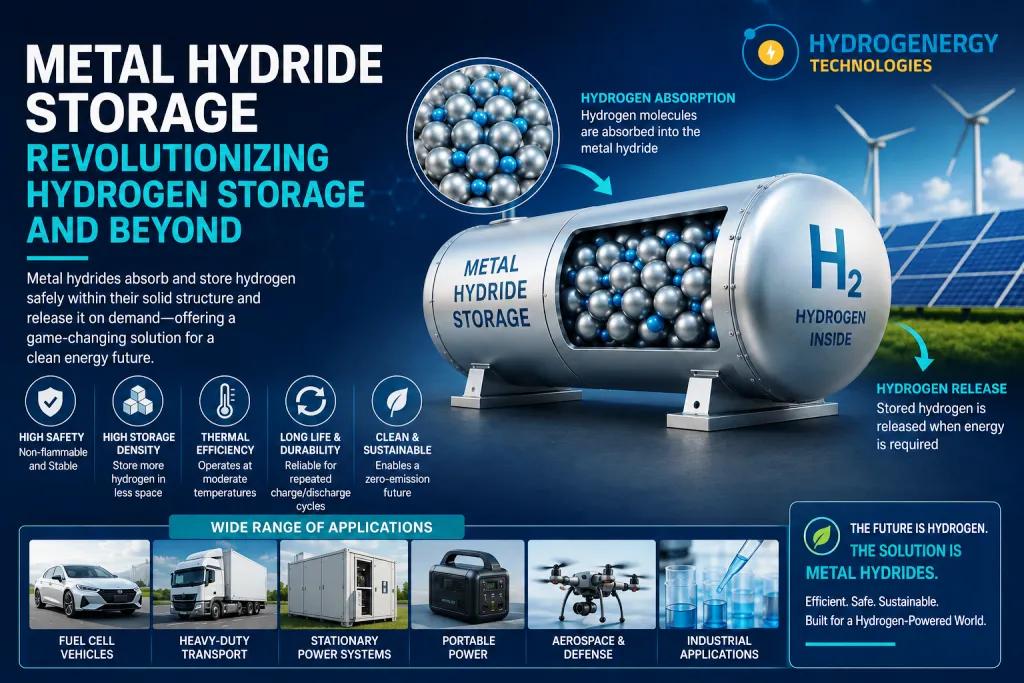
Hydrogen is a clean and versatile energy carrier with real potential for reducing greenhouse gas emissions, particularly in fuel cell vehicles and industrial applications. But efficiently storing and transporting hydrogen remains a genuine challenge, traditionally addressed through high-pressure gas cylinders. Metal hydride storage offers a fundamentally different approach, and by 2026 it has moved from a promising alternative into real commercial deployment. This article covers how metal hydride storage works, how it compares to other storage methods, and where the technology genuinely stands today.
How Metal Hydride Storage Works
Metal hydride storage relies on the ability of certain metals to absorb and release hydrogen gas through a reversible chemical reaction, forming metal hydrides on absorption and releasing hydrogen again when temperature or pressure is adjusted.
Absorption: hydrogen gas is introduced to the metal hydride material under specific temperature and pressure conditions, and hydrogen molecules penetrate the metal's lattice structure, binding with the metal atoms to form metal hydrides.
Storage: once absorbed, the metal hydrides store hydrogen within their lattice structure. The amount that can be stored depends on the specific metal hydride composition, common alloy families include titanium-iron (Ti-Fe) types, which avoid rare earth elements and keep production costs relatively low, and rare-earth-containing alloys like LaNi5, which offer faster kinetics at the cost of higher material expense.
Release: adjusting temperature and pressure causes the metal hydride lattice to release its bound hydrogen, which can then be used in fuel cells or other applications.
Comparing Metal Hydride to Other Storage Methods
Comparing Metal Hydride to Other Storage Methods
| Factor | Metal Hydride | Compressed Gas | Liquid Hydrogen |
|---|---|---|---|
| Operating pressure | Low (a few bar typically) | High (up to 700 bar) | Low, but requires cryogenic cooling |
| Volumetric density | High | Moderate | Highest |
| Safety profile | Very high, low pressure reduces failure risk | Moderate, high-pressure vessels required | Moderate, cryogenic handling risks |
| Weight | Heavier per unit hydrogen stored | Lighter | Lightest |
| Release behavior | Slow, controlled | Instant on valve opening | Instant, with ongoing boil-off |
| Best suited for | Stationary storage, controlled-release applications | Vehicles, fuelling stations | Long-distance transport, large-scale storage |
Advantages and Disadvantages
Advantages include improved safety (reduced risk of accidents associated with high-pressure gas storage, since metal hydrides operate at much lower pressures), efficiency (higher hydrogen storage capacity in a smaller volume than compressed gas), sustainability (many metal hydride formulations use abundant, non-toxic elements, particularly Ti-Fe alloys), and versatility (applicable to industrial processes beyond energy storage, including nickel-metal hydride battery anodes).
Disadvantages include cost (initial costs can be higher than conventional gas cylinder storage, particularly for rare-earth-containing alloys), weight (metal hydride systems are typically heavier than equivalent gas cylinders, a genuine constraint for mobile applications), and limited operating temperature ranges for some specific metal hydride materials.
Fueling Fuel Cell Vehicles
Metal hydride storage offers several genuine advantages for fuel cell vehicles specifically: reduced leakage risk given the low operating pressure, controlled and steady hydrogen release matching fuel cell demand, improved range from higher storage density, and comparatively fast refuelling versus on-demand electrolysis-based generation. The weight penalty remains the primary trade-off limiting wider automotive adoption compared to compressed gas, which is why metal hydride storage has found more traction in stationary and specialty mobile applications than passenger vehicles specifically.
Testing and validating hydrogen storage and release characteristics for a metal hydride system typically relies on the same kind of pressure and purity monitoring instrumentation used across other hydrogen storage technologies.
Real-World Commercial Progress
GKN Hydrogen, a long-established player in metal hydride storage, has built out real commercial partnerships, including a June 2024 memorandum of understanding making ZYNP its exclusive metal hydride storage partner in the Chinese market, and a December 2023 agreement with Mitsubishi Corporation Technos to market its metal hydride solutions in Japan, targeting decentralized, grid-independent power for industrial facilities and hospital backup systems.
Hydrexia, specializing in magnesium-based metal hydride storage, completed the first regional maritime shipment of its MHX solid-state metal hydride hydrogen storage container in February 2026, a genuine milestone demonstrating commercial viability for cross-border metal hydride-based hydrogen transportation, not just stationary use.
SolidHydrogen and Tellus Materials signed their first commercial order in July 2026 for a combined hydrogen purification, compression and storage system using metal hydride technology, another concrete signal of the technology moving from pilot demonstration toward real commercial deployment.
The broader hydrogen storage alloy market reflects this momentum too: valued at roughly $1.91 billion in 2025, it's projected to reach $4.37 billion by 2034, with Asia Pacific currently holding the largest regional share at just over 41%, driven heavily by Chinese and Japanese investment in hydrogen infrastructure.
Conclusion
Metal hydride storage has moved from a promising laboratory concept into genuine commercial deployment, evidenced by GKN Hydrogen's real market partnerships, Hydrexia's first maritime shipment in February 2026, and SolidHydrogen's July 2026 commercial order. Its combination of safety, density and controlled release makes it a genuinely strong fit for stationary energy storage and specialty applications, even as weight continues to limit its adoption in mainstream passenger vehicles compared to compressed gas. As alloy costs and system weight continue to improve, metal hydride storage is well positioned to keep expanding its role in the broader hydrogen storage landscape.
Need help with your hydrogen project?
Our engineers respond within 24 hours with a recommendation.

Hydrogenergy Applications Engineering Team
Applications Engineering · Hydrogenergy Technologies
Hydrogenergy's applications engineering team designs and supplies hydrogen systems for research labs and industry across India — from components to complete commissioned setups.