Quick Definition
An alkaline electrolyzer is a water electrolysis system that uses an alkaline electrolyte, typically potassium hydroxide (KOH) or sodium hydroxide (NaOH), to split water into hydrogen and oxygen using electricity. As one of the most mature and cost-effective hydrogen production technologies, it is widely used for large-scale green hydrogen generation powered by renewable energy.
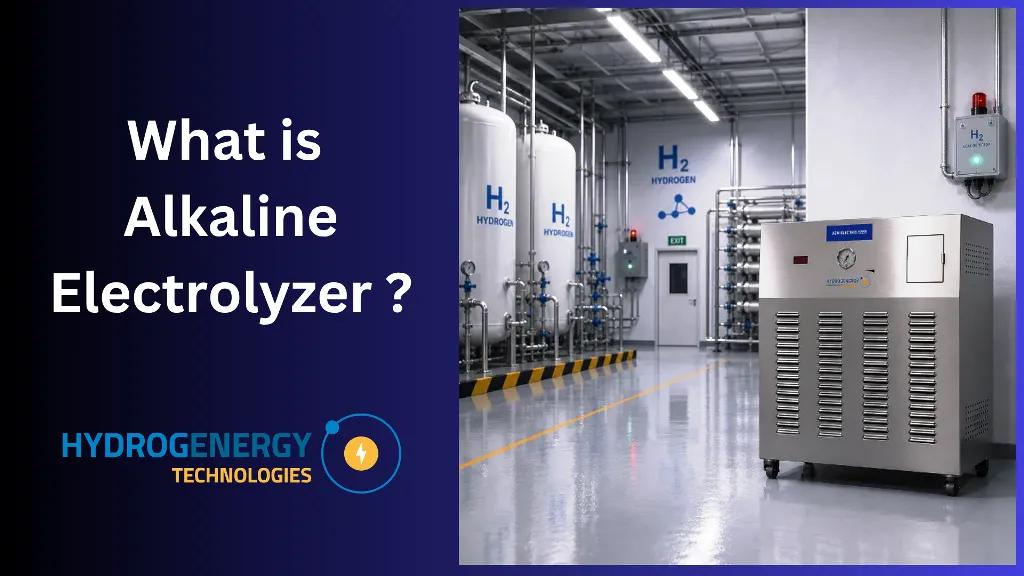
As we look for cleaner and more sustainable energy sources, green hydrogen has emerged as a front-runner, and alkaline electrolyzers remain one of the key technologies enabling it. This article covers how alkaline electrolyzers work, how they compare to other electrolyzer types, and where the market genuinely stands in 2026.
Understanding Alkaline Electrolyzers
An alkaline electrolyzer takes in water and electricity and produces hydrogen and oxygen gases. It uses an alkaline solution made of potassium hydroxide (KOH) or sodium hydroxide (NaOH), which carries electric current between two electrodes, usually made of nickel or stainless steel. The anode attracts the negative parts of water molecules and the cathode attracts the positive parts; when electricity passes through the solution, it splits water molecules into hydrogen and oxygen, with hydrogen gathering at the cathode and oxygen at the anode.
Alkaline electrolyzers have been in use since the early 1900s, and industries like fertilizers, chemicals, and oil refining have relied on them for decades to produce hydrogen, well before the current green hydrogen push began.
Alkaline vs. Other Electrolyzer Technologies
| Factor | Alkaline | PEM | AEM |
|---|---|---|---|
| Global market share (2025) | 49%, the largest single segment | Second largest, growing fast | Smallest, highest projected CAGR |
| Capital cost | Lowest (~1,666 €/kW in Europe, 2023) | Higher | Moderate |
| Efficiency | Lower than PEM | Higher | Comparable to PEM in newer designs |
| Response to load changes | Slower to start and adjust | Fast, suits variable renewable input well | Fast |
| Maturity | Most mature, over a century of industrial use | Mature, scaling rapidly | Emerging |
| Best suited for | Large-scale, steady-load industrial production | Applications needing fast response to variable renewable power | Applications wanting PEM-like performance without precious metal catalysts |
For a closer look at how these three technologies compare directly, including SOEC as a fourth emerging option, see our SOEC vs AEM vs PEM electrolyzer comparison.
Advantages and Disadvantages
Advantages include being a proven technology with decades of well-understood performance and longevity, generally lower cost to build and operate than PEM electrolyzers, strong suitability for large-scale production, and durable construction able to handle the harsh alkaline environment without frequent replacement.
Disadvantages include lower efficiency than newer technologies (using more electricity per unit of hydrogen produced), wear from the strong alkaline solution over time, purity issues in the produced hydrogen that may require additional purification steps, and slower startup and response times, making alkaline systems less ideal for applications needing rapid load adjustments.
Hydrogenergy supplies alkaline electrolyzer systems across bench-top, cabinet, skid-mounted and containerised configurations, spanning small-scale lab use through pilot-scale and industrial production.
The Market in 2026
Alkaline electrolyzers remain the backbone of global electrolyzer capacity, holding roughly 49% market share as of 2025, the largest single segment across all electrolyzer technologies, driven by proven reliability and lower capital expense (roughly 1,666 €/kW in Europe as of 2023 figures).
Standardized modular designs are enabling much larger installations than were practical a decade ago. Thyssenkrupp Nucera's "scalum" module design, for example, has supported multi-megawatt installations including a 700 MW deployment for green steel production in Europe. Nel ASA was awarded €135 million from the EU Innovation Fund in October 2024 specifically for industrializing next-generation pressurized alkaline technology, and John Cockerill raised a $134.5 million capital increase in June 2025 to scale up production of its next-generation pressurized alkaline electrolyzers. McPhy Energy has also continued expanding its high-capacity alkaline offering and manufacturing capacity through 2026.
These developments point to real, funded scale-up activity across multiple major manufacturers, not just projected future growth.
Future Prospects
Ongoing research continues to target efficiency improvements through new electrode materials and cell designs, increased durability through materials better able to withstand the alkaline environment over long operating periods, and improved integration with variable renewable electricity sources like wind and solar, addressing one of alkaline technology's traditional weak points relative to PEM.
Ambitious national climate goals, the use of excess renewable electricity for grid balancing via hydrogen production, and the broader build-out of a global hydrogen economy spanning transport, industry and energy storage will continue to drive demand. Genuine challenges remain too, including continued cost reduction, hydrogen storage and distribution infrastructure development, consistent policy support, and public awareness around green hydrogen's benefits and safety.
Conclusion
Alkaline electrolyzers remain a cornerstone technology in the transition to green hydrogen, offering a mature, cost-effective, and genuinely scalable solution, still holding the largest share of global electrolyzer capacity even as PEM and AEM technologies gain ground. Real, funded scale-up activity from major manufacturers through 2025 and 2026 shows this isn't a static, legacy technology but one still seeing meaningful innovation, particularly around modular design and renewable energy integration.
Need help with your hydrogen project?
Our engineers respond within 24 hours with a recommendation.
Hydrogenergy Applications Engineering Team
Applications Engineering · Hydrogenergy Technologies
Hydrogenergy's applications engineering team designs and supplies hydrogen systems for research labs and industry across India — from components to complete commissioned setups.