Quick Definition
An electrolyzer is an electrochemical device that uses electricity to split water into hydrogen and oxygen through the process of electrolysis. Depending on the type of electrolyte and operating conditions, electrolyzers are classified into Proton Exchange Membrane (PEM), Anion Exchange Membrane (AEM), and Solid Oxide Electrolyzer Cell (SOEC) technologies, each offering distinct advantages in efficiency, operating temperature, cost, and application suitability.
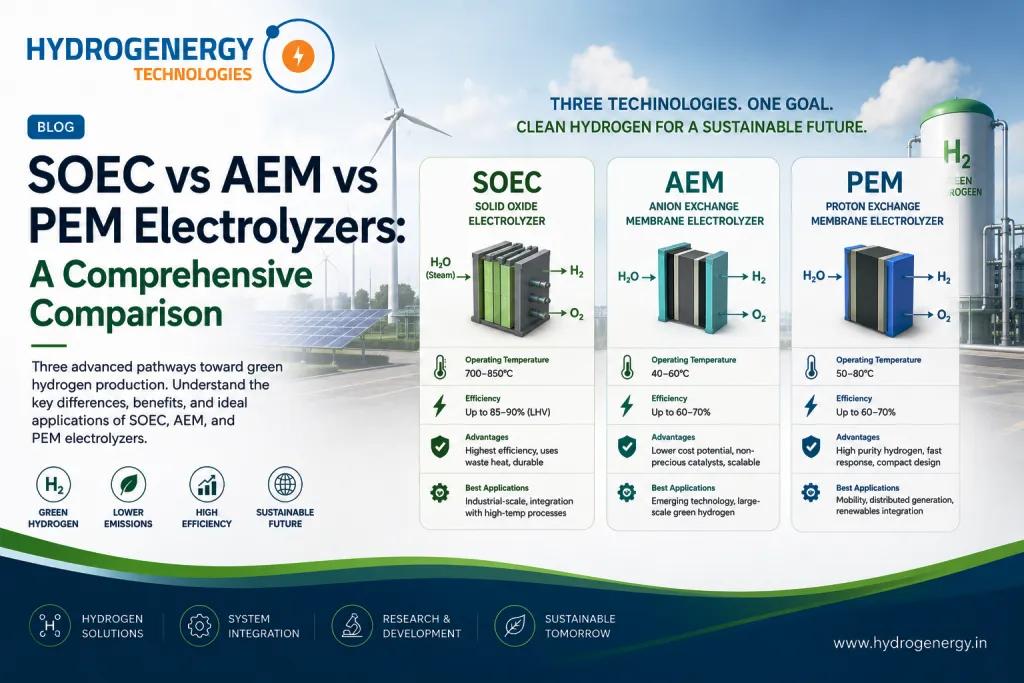
SOEC, AEM, and PEM Electrolyzers: A Comparison
Electrolyzers are devices that use electricity to split water into hydrogen and oxygen. They're used across hydrogen production for fuel cells, industrial feedstock, and increasingly, grid-scale energy storage. There are three main electrolyzer technologies in commercial and near-commercial use today: solid oxide electrolyzer cells (SOEC), anion exchange membranes (AEM), and proton exchange membranes (PEM), each with genuinely different strengths suited to different applications.
Solid Oxide Electrolyzer Cell (SOEC)
SOECs typically operate at 700 to 1000°C, enabling efficient electrolysis of steam using both electrical and thermal energy. The solid oxide ceramic electrolyte allows direct conversion of water vapor into hydrogen and oxygen. SOECs can handle various feedstocks including steam and, in some configurations, carbon dioxide, making them versatile for co-electrolysis applications. Their high conversion efficiency (up to roughly 90%) and ability to use waste heat make them well suited to large-scale industrial hydrogen production, particularly when paired with an existing heat source. For a deeper look at the technology and its current commercial landscape, including real companies actively scaling SOEC manufacturing, see our dedicated guide to solid oxide electrolyzers.
Anion Exchange Membrane Electrolyzer (AEM)
AEM electrolyzers operate at lower temperatures, typically below 100°C, using a specialized membrane that selectively conducts hydroxide ions to facilitate water splitting. AEM is often positioned as combining advantages of both alkaline and PEM technology: it avoids the precious metal catalysts PEM requires, while offering faster response and better scalability than traditional alkaline systems. AEM electrolyzers suit decentralized hydrogen production and renewable energy storage well, with rapid start-up and shutdown enabling efficient load-following. AEM technology also tolerates water impurities better than PEM, reducing the water purification burden.
Proton Exchange Membrane Electrolyzer (PEM)
PEM electrolyzers operate at low temperatures below 100°C, using a solid polymer electrolyte membrane that selectively conducts protons. They're known for compactness, high conversion efficiency, and fast response to fluctuating electrical input, making them well suited to integration with variable renewable energy sources. This combination of compactness and rapid response is why PEM remains the dominant choice for hydrogen refuelling stations, fuel cell vehicles, and research applications requiring dynamic operation. Hydrogenergy's PEM electrolyzer systems span bench-top research units through industrial-scale systems producing up to 10 Nm³/hr.
Side-by-Side Comparison Table
Side-by-Side Comparison Table
| Factor | SOEC | AEM | PEM |
|---|---|---|---|
| Operating temperature | 700 to 1000°C | Below 100°C | Below 100°C |
| Typical efficiency | Up to ~90% | Comparable to PEM in newer designs | ~60 to 70% |
| Catalyst requirement | Ceramic materials, no precious metals | No precious metals needed | Requires platinum/iridium catalysts |
| Startup speed | Slow | Fast | Fast |
| Water purity requirement | Tolerates impurities, including some CO2 feedstocks | More tolerant than PEM | Requires high-purity water |
| Best suited for | Large-scale industrial, especially with waste heat available | Decentralized production, renewable storage | Refuelling stations, vehicles, research, variable renewable integration |
| Commercial maturity (2026) | Emerging, GW-scale manufacturing investment underway | Emerging, smallest market share but growing | Mature, widely commercially deployed |
Choosing the Right Technology
The practical choice usually comes down to three questions: how much continuous, large-scale hydrogen demand exists (favoring SOEC or alkaline over PEM or AEM), how much the application needs fast response to variable power input (favoring PEM or AEM over SOEC), and how much catalyst cost matters relative to overall system budget (favoring AEM or alkaline over PEM). For research and testing environments specifically, PEM's combination of fast response, compactness, and widespread equipment availability makes it the most common starting point, which is why it remains Hydrogenergy's primary electrolyzer offering across bench-top through industrial-scale systems.
Conclusion
SOEC, AEM, and PEM each serve genuinely different niches within hydrogen production rather than competing head-to-head for the same applications. SOEC's efficiency and feedstock flexibility suit large-scale industrial production with available waste heat. AEM offers a middle ground, avoiding PEM's precious metal catalysts while improving on traditional alkaline's response time. PEM's compactness and fast response keep it the practical default for refuelling infrastructure, vehicles, and research applications requiring dynamic operation. Understanding these genuine trade-offs, rather than treating one technology as universally "best," is the right starting point for specifying an electrolyzer for any given application.
Need help with your hydrogen project?
Our engineers respond within 24 hours with a recommendation.
Hydrogenergy Applications Engineering Team
Applications Engineering · Hydrogenergy Technologies
Hydrogenergy's applications engineering team designs and supplies hydrogen systems for research labs and industry across India — from components to complete commissioned setups.