Quick Definition
Hydrogen can be produced through multiple pathways, each with different feedstocks, costs, efficiencies, and environmental impacts. Electrolysis uses electricity to split water into hydrogen and oxygen, steam methane reforming (SMR) extracts hydrogen from natural gas, and biomass gasification converts organic materials into hydrogen-rich syngas. Choosing the appropriate production method depends on factors such as carbon emissions, feedstock availability, scalability, and application.
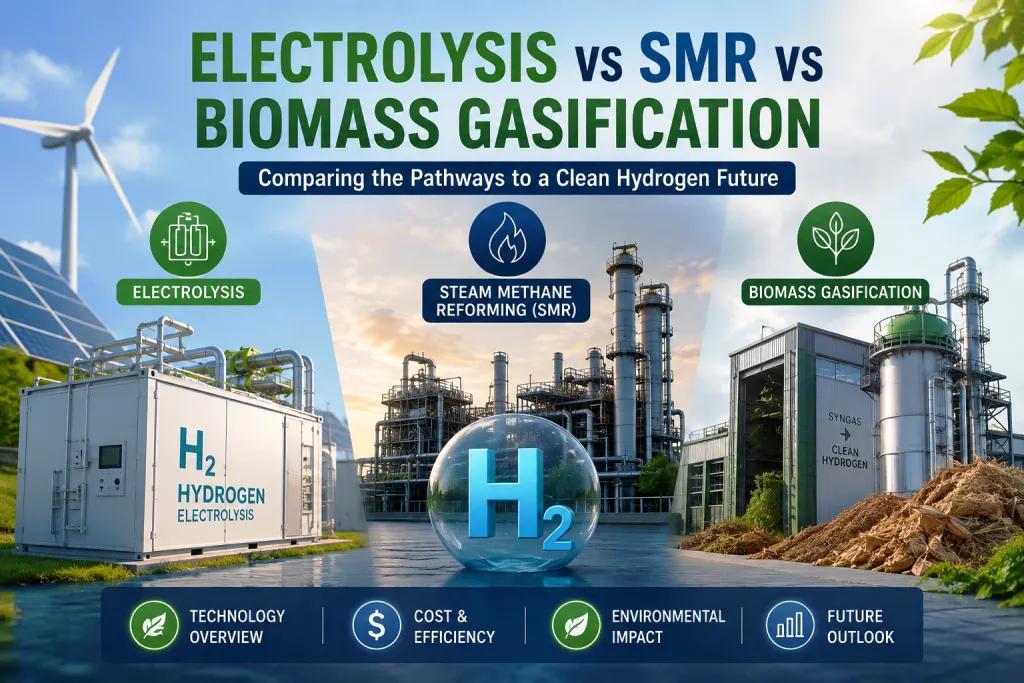
Hydrogen, the most abundant element in the universe, is poised to play a transformative role in the transition towards a clean and sustainable energy future. Unlike fossil fuels, when used in a fuel cell, hydrogen produces only water vapor as a byproduct, making it a zero-emission fuel source at the point of use. But hydrogen doesn't exist freely in nature the way oil or natural gas do, unlocking its potential relies on production methods, each with genuinely different costs, emissions profiles and scale. This article covers three of the most discussed hydrogen production pathways: electrolysis, steam methane reforming, and biomass gasification, and where each actually stands in the global production mix today.
Global Production Mix: The Real Picture
Globally, hydrogen production remains dominated by fossil fuels. Steam methane reforming accounts for roughly 76% of global production, coal gasification (concentrated heavily in China) accounts for around 22%, and electrolysis makes up only about 1-2%. Biomass gasification, despite genuine promise, remains a minor, largely emerging pathway rather than a meaningful share of global supply today.
That said, the growth trajectory for electrolysis is real. According to the IEA's Global Hydrogen Review 2026, installed electrolysis capacity doubled in 2025 to surpass 4 GW globally, driven by several large-scale projects commissioned in China, with more than 2.5 GW under construction targeting operation in 2026. Growth is expected to continue, particularly in Europe, though investment momentum slowed in 2025 and electrolyzer manufacturing is entering a consolidation phase as the market develops more slowly than earlier projections assumed.
Electrolysis: The Clean Energy Champion
Electrolysis uses electricity to split water molecules (H2O) into their constituent parts: hydrogen (H2) and oxygen (O2). The key factor is the source of that electricity. When powered by renewable energy sources like solar or wind, electrolysis produces green hydrogen, a carbon-neutral fuel with zero harmful emissions at the point of production.
During electrolysis, electricity passes through an electrolytic cell equipped with two electrodes (anode and cathode) submerged in water. The electricity separates the water molecules at the electrodes, with hydrogen accumulating at the cathode and oxygen at the anode. Several electrolyzer technologies exist with varying efficiencies and operational characteristics: PEM electrolyzers offer compact design and fast response to variable power input, alkaline electrolyzers remain the most mature and cost-effective for large-scale steady production, and solid oxide electrolyzers offer higher efficiency at the cost of high operating temperature and slower response.
Electrolysis is highly scalable and modular, allowing deployment in distributed locations where hydrogen is needed, without the fossil feedstock dependency of SMR. The main constraint remains electricity cost, though this continues to improve as renewable energy prices fall.
Steam Methane Reforming: Still the Dominant Method
Steam methane reforming (SMR) remains the single largest hydrogen production method globally, accounting for roughly three-quarters of global supply. It's a well-established, reliable technology with relatively low setup and operating costs compared to other methods.
SMR relies on a high-temperature chemical reaction between steam (H2O) and methane (CH4), the main component of natural gas. This process breaks down methane molecules to produce hydrogen, carbon monoxide (CO), and carbon dioxide (CO2). The biggest drawback is its reliance on fossil fuels: the SMR process itself generates greenhouse gas emissions, and extraction and processing of natural gas carries its own environmental impact. Technologies like SMR with Carbon Capture and Storage (CCS), producing what's often called blue hydrogen, can capture a significant portion of CO2 emissions, though this adds complexity and cost, and outcomes depend heavily on actual capture rate and upstream methane leakage.
Biomass Gasification: A Promising but Minor Pathway
Biomass gasification offers a genuinely more sustainable alternative to SMR in principle, though it remains a small share of actual global production today. This method harnesses organic matter like wood chips or agricultural waste to produce a hydrogen-rich gas mixture.
The process involves heating organic material in a controlled environment with limited oxygen, breaking down the biomass into syngas (synthesis gas) containing hydrogen, carbon monoxide, and other gases, which is then further processed to separate hydrogen. If the biomass source is sustainably managed, the process can approach carbon neutrality, since CO2 released during production can be reabsorbed by future biomass growth, creating something closer to a closed carbon loop. The genuine limitation is scale: biomass gasification hasn't yet reached anywhere near the production volumes of SMR or even electrolysis globally, making it more of an emerging, niche pathway than a mainstream production route today.
Comparing the Three Methods
Comparing Electrolysis, SMR and Biomass Gasification
| Factor | Electrolysis | SMR | Biomass Gasification |
|---|---|---|---|
| Global production share | ~1-2% | ~76% | Minimal, emerging |
| Primary feedstock | Water + electricity | Natural gas | Organic biomass |
| Carbon emissions | Zero (if renewably powered) | High (unless paired with CCS) | Near carbon-neutral, if sustainably sourced |
| Cost today | Higher, falling | Lowest | Moderate to high |
| Scalability | High, growing fast (capacity doubled globally in 2025) | Already at massive scale | Limited by biomass supply chains |
| Best suited for | Distributed, renewable-powered production | Large industrial-scale production where cost is the priority | Niche applications with reliable local biomass supply |
The Road Ahead
The future of hydrogen production is a genuinely dynamic landscape, though real-world progress is more gradual and uneven than headline announcements sometimes suggest. Electrolysis capacity is growing quickly in absolute terms, doubling globally in 2025, even as it remains a small fraction of total production and the sector navigates a period of slower investment and manufacturing consolidation. SMR with CCS may play a meaningful transitional role, while biomass gasification's contribution remains more promising in theory than in current deployed scale. Choosing the right production technology for a specific application depends on genuinely weighing cost, feedstock availability, emissions requirements and scale, rather than assuming one pathway will simply replace the others industry-wide in the near term.
Need help with your hydrogen project?
Our engineers respond within 24 hours with a recommendation.

Hydrogenergy Applications Engineering Team
Applications Engineering · Hydrogenergy Technologies
Hydrogenergy's applications engineering team designs and supplies hydrogen systems for research labs and industry across India — from components to complete commissioned setups.