H₂ Products

All Products
Electrolyzers
Fuel Cells
H₂ Leak Detectors
Dew Point Meters
Hydrogen Purity Analyzers
Mass Flow Controllers
Digital Pressure Gauges
MEA & Materials

Can't find what you need? We source custom components.

Custom Request →
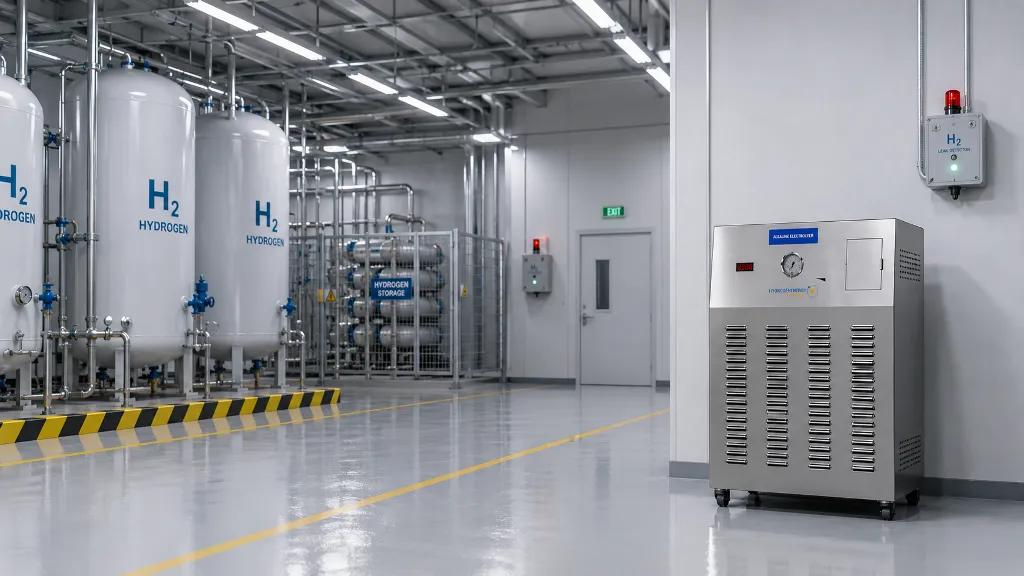
Alkaline Electrolyzer with leak detector
ProductselectrolyzersAlkaline Electrolyzers

Alkaline Electrolyzers

Bench-top · Cabinet · Skid · Containerised

Alkaline electrolyzers for continuous hydrogen generation — from compact bench-top units at 300 mL/min to large skid-mounted and containerised systems at 2000 Nm³/hr. Single phase for small-scale applications, three phase for industrial and pilot-scale production.

Products

HAES-300Alkaline Electrolyzer

Compact bench-top alkaline electrolyzer. 300 mL/min hydrogen output at >99.8% purity. Single phase AC, regulated 0.2–4 bar output.

Lead time: 4–6 weeks

Specifications
Flow Rate300 mL/min
Hydrogen Purity>99.8%
Output Pressure0.2–4 bar (regulated)
Rated Power<150 W
Power SupplySingle Phase AC
Dimensions420 × 230 × 360 mm
Weight<15 kg

What is an Alkaline Electrolyzer?

An alkaline electrolyzer produces hydrogen by passing electrical current through a potassium hydroxide (KOH) solution between two electrodes separated by a diaphragm. At the cathode, water is reduced to hydrogen gas. Hydroxide ions migrate through the diaphragm to the anode, where oxygen is released. The hydrogen is then separated from the liquid electrolyte, dried and delivered at the outlet at the specified purity and pressure.

Alkaline electrolysis is the most established electrolyzer technology — with decades of industrial deployment and a well-understood maintenance profile. It delivers reliable performance at higher flow rates and lower capital cost per unit of hydrogen output compared to PEM at equivalent capacities. Alkaline systems are best suited to steady-state operation rather than intermittent or rapidly fluctuating power input, and require periodic KOH electrolyte management.

Hydrogenergy supplies alkaline electrolyzers from 300 mL/min bench-top units through to fully customised containerised and skid-mounted systems for industrial hydrogen production.

Applications

Continuous industrial hydrogen generation
Pilot-scale hydrogen production facilities
Hydrogen storage and compression systems
Power-to-gas and energy storage projects
Hydrogen fuelling infrastructure
Process gas supply for industrial applications
Hydrogen safety and sensor calibration

Frequently asked questions

What is the minimum order for an alkaline electrolyzer?
Hydrogenergy supplies alkaline electrolyzers as single units with no minimum order requirement. Bench-top units from the HAES-300 to HAES-7000 series are available individually. For large industrial systems — skid-mounted, containerised or custom configurations — lead times and minimum quantities are confirmed at the enquiry stage.
What is the difference between the bench-top series and the industrial series?
The bench-top series (HAES-300 to HAES-7000) operates on single phase AC, produces hydrogen at 0.2–4 bar regulated output, and covers flow rates from 300 mL/min to 7000 mL/min. These are compact, self-contained units suited for testing, instrumentation supply and small-scale generation. The industrial series (HAES-1 to HAES-10) operates on three phase AC, delivers hydrogen at 10–32 bar, and covers 1–10 Nm³/hr — suited for pilot-scale and continuous industrial hydrogen production.
Does an alkaline electrolyzer require a separate power supply?
No — all HAES series units include an integrated power supply and operate directly from AC mains. Bench-top units (HAES-300 to HAES-7000) require single phase 230V, 50Hz. Industrial units (HAES-1 to HAES-10) require three phase supply. Large custom systems may have specific electrical infrastructure requirements confirmed at the project design stage.
What maintenance does an alkaline electrolyzer require?
Alkaline electrolyzers require periodic KOH electrolyte concentration monitoring and top-up, diaphragm inspection at scheduled intervals, and electrode and separator replacement over the longer operational life of the system. The frequency of maintenance depends on operating hours and duty cycle. Hydrogenergy provides technical documentation and can advise on maintenance schedules for each unit in the range.
Can alkaline electrolyzers be used with solar or variable power input?
Alkaline electrolyzers are best suited to steady or slowly varying power input — they have slower dynamic response than PEM systems and do not handle rapid load fluctuations as well. For solar or variable renewable-coupled operation where power input changes quickly, a PEM electrolyzer is more appropriate. Alkaline systems can be used in renewable-coupled configurations where power conditioning or battery buffering smooths the input profile.
Need help choosing the right model?
Our engineers will recommend the right alkaline electrolyzers for your application.
Talk to an Engineer →