Academic Labs

All Lab Systems
Solar to Hydrogen Production Learning SystemPEM Fuel Cell Learning SystemFuel Cell Electric Vehicle Learning SystemFuel Cell Benchmarking System

Need a custom lab configuration?

Discuss Your Lab →
Solar to Hydrogen Production Learning System
Academic Labs · Solar to Hydrogen Production Learning System

Solar to Hydrogen Production Learning System

Solar energy in, pure hydrogen out — green hydrogen production for university labs.

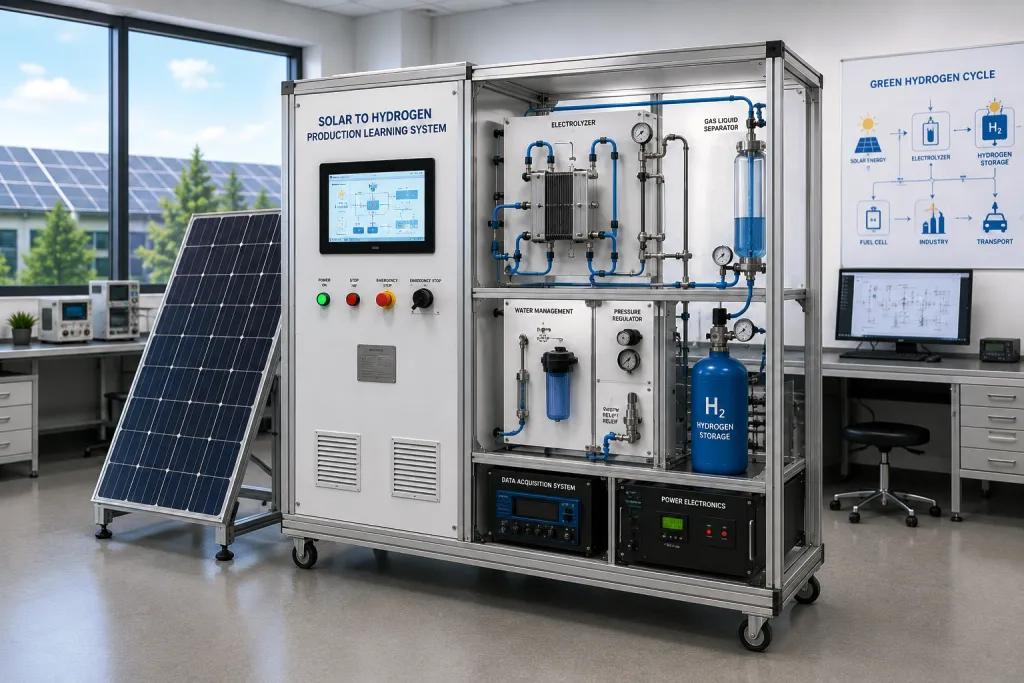
The Solar to Hydrogen Production Learning System demonstrates how renewable solar energy can be directly converted into stored green hydrogen. A solar PV array feeds a grid-tied inverter which powers a high-capacity alkaline electrolyzer. The electrolyzer produces up to 3000 ml/min of hydrogen at 0.4 MPa, which is dried to greater than 99.99% purity and stored in a high-pressure cylinder for further use. The system is fully instrumented, continuously operable and designed for indoor university and research institution labs.

Solar to Hydrogen Production Learning System

Specifications

Energy SourceSolar PV + Grid-Tied Inverter
Electrolyzer TypeAlkaline, 18% KOH
H₂ Output Volume0–3000 ml/min
H₂ Output Pressure0.4 MPa
Overpressure Protection0.5 MPa
H₂ Purity>99.99%
Electrolyzer Power<2100 W
Electrolyzer Weight<100 kg
Lye Tank Capacity15 L
Water Distiller Output<20 µS/cm
Water Distiller RateUp to 1 L/hr
Water Distiller Power500 W
Water Tank Capacity10 L
H₂ Storage Cylinder10 L, 5 kg/cm²
Manifold Pressure Gauge0–10 bar (dual)
H₂ Leak Detectors2 nos. — electrolyzer and manifold
Leak Alarm Trigger20 ppm H₂
H₂ Detection Range0–100 ppm
Safety ActionAuto shutdown + solenoid valve cutoff
UsageIndoor

What this system does

The Solar to Hydrogen Production Learning System puts the core green hydrogen production pathway in a single academic installation. A solar PV array generates DC electricity which is converted to AC through a grid-tied inverter and fed to the alkaline electrolyzer. The electrolyzer uses 18% KOH electrolyte to split distilled water into hydrogen and oxygen, producing hydrogen at up to 3000 ml/min at 0.4 MPa. An integrated water distiller produces distilled water from ordinary tap or rain water on-site — no external DI water supply is required. The hydrogen is passed through a desiccant dryer to remove moisture, achieving greater than 99.99% purity, and stored in a 10L industrial-grade cylinder at regulated pressure. Two hydrogen leak detectors — positioned above the electrolyzer and manifold — monitor the environment continuously and trigger automatic shutdown and solenoid valve cutoff at 20 ppm. Students can monitor solar PV output, measure electrolyzer performance across varying irradiance conditions, study the relationship between solar power input and hydrogen production rate, and investigate the effect of pressure on hydrogen output. The modular design allows additional electrolyzers to be connected in parallel and the system to be developed as a hybrid grid-connected platform as research needs grow.

What's included

Solar PV array with monitoring for irradiance and temperature
Grid-tied inverter : converts solar DC to AC for electrolyzer supply
Water distiller: produces distilled water from tap or rain water, <20 µS/cm, up to 1 L/hr, 500W
10 L water tank module : water input conductivity <1 µS/cm
Alkaline electrolyzer : 0–3000 ml/min, 18% KOH, 0.4 MPa, <2100W
Desiccant hydrogen dryer : removes moisture, delivers >99.99% pure dry H₂
10L industrial-grade hydrogen storage cylinder at 5 kg/cm²
Pressure regulation manifold with dual pressure gauges (0–10 bar)
2 × hydrogen gas leak detectors : above electrolyzer and manifold with automatic shutdown and solenoid valve cutoff
Illustrated experiment manual with wiring diagrams and experiment procedures
On-site installation, commissioning and faculty training

Experiments this system enables

I-V and P-V characterisation of the solar PV array at different irradiance levels
Variation of hydrogen output volume with electrolyzer input power
Effect of operating pressure on hydrogen production rate and electrolyzer efficiency
Water quality impact on alkaline electrolyzer performance
Hydrogen storage pressure characterisation across a filling cycle
Gas pressure measurement at multiple points in the hydrogen circuit
Simultaneous monitoring of solar generation and hydrogen production
Safety system testing — leak detection, emergency shutdown and solenoid valve cutoff
Hydrogen as a solar energy storage medium — full pathway demonstration
Expansion study — parallel electrolyzer operation and increased production rates
Grid-connected system design and energy management

Technical features

Solar-powered electrolysis

Grid-tied inverter converts solar PV output to drive the alkaline electrolyzer — students directly observe the link between solar irradiance and hydrogen production rate

High-capacity alkaline electrolyzer

0–3000 ml/min hydrogen production at 0.4 MPa — produces measurable stored volumes suitable for extended experiments and downstream fuel cell use

On-site water production

Integrated water distiller produces distilled water from tap or rain water — no external DI supply, no consumables to procure

Two-point leak detection

Detectors above the electrolyzer and manifold — automatic shutdown and solenoid cutoff at 20 ppm H₂ regardless of system state

Modular and expandable

Additional electrolyzers can be added in parallel to increase production; system expandable to grid-connected or hybrid configurations

Continuous operation

Tested for uninterrupted operation without mandatory shutdown intervals — suitable for extended research runs

Applications

University green hydrogen production and storage labsSolar energy to hydrogen conversion researchAlkaline electrolyzer performance and characterisation studiesRenewable energy storage research using hydrogenUndergraduate and postgraduate green hydrogen technology courses

Frequently asked questions

Ready to build your hydrogen lab?
Our team will prepare a detailed proposal for your institution within 48 hours.