Academic Labs

All Lab Systems
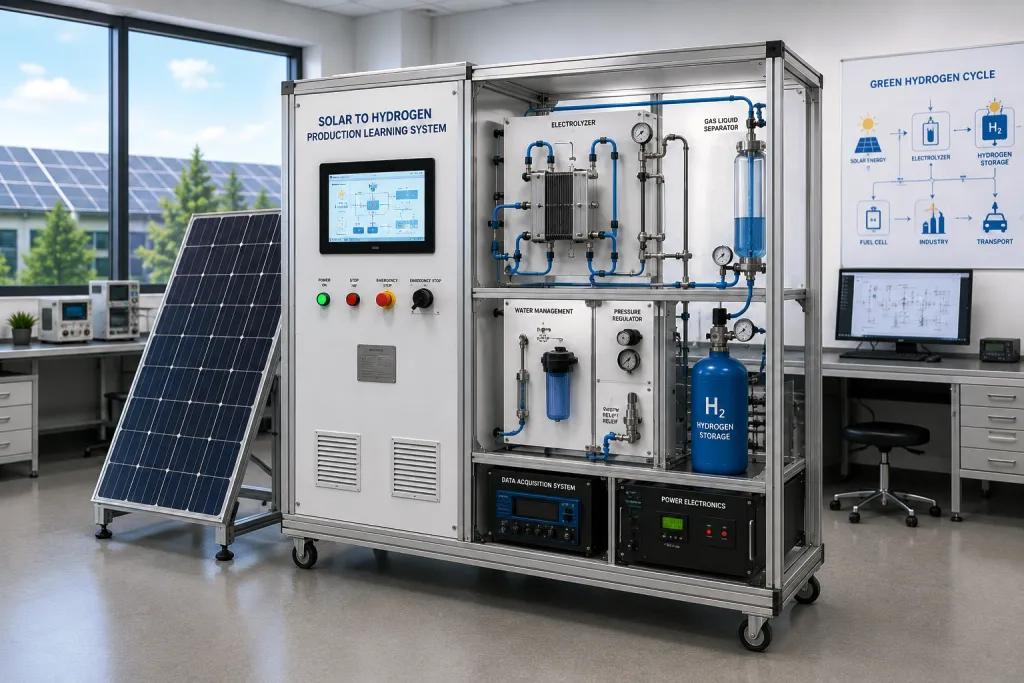
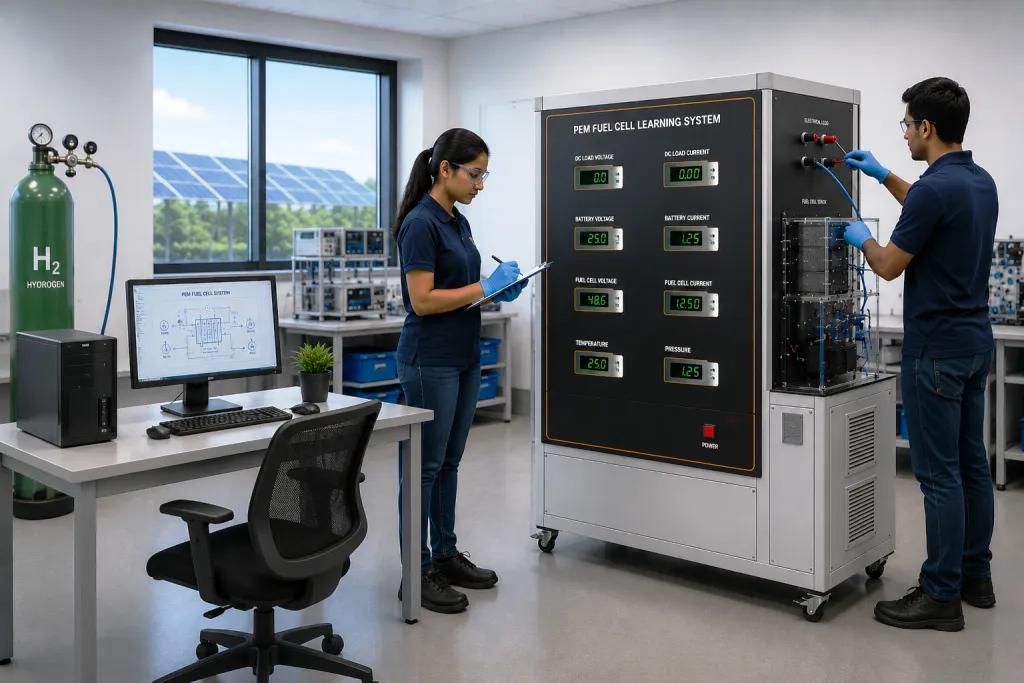
Solar to Hydrogen Production Learning SystemPEM Fuel Cell Learning SystemFuel Cell Electric Vehicle Learning SystemFuel Cell Benchmarking System

Need a custom lab configuration?

Discuss Your Lab →
Fuel Cell Electric Vehicle Learning System
Academic Labs · Fuel Cell Electric Vehicle Learning System

Fuel Cell Electric Vehicle Learning System

48V fuel cell hybrid drivetrain — from hydrogen to wheel on a research test bench.

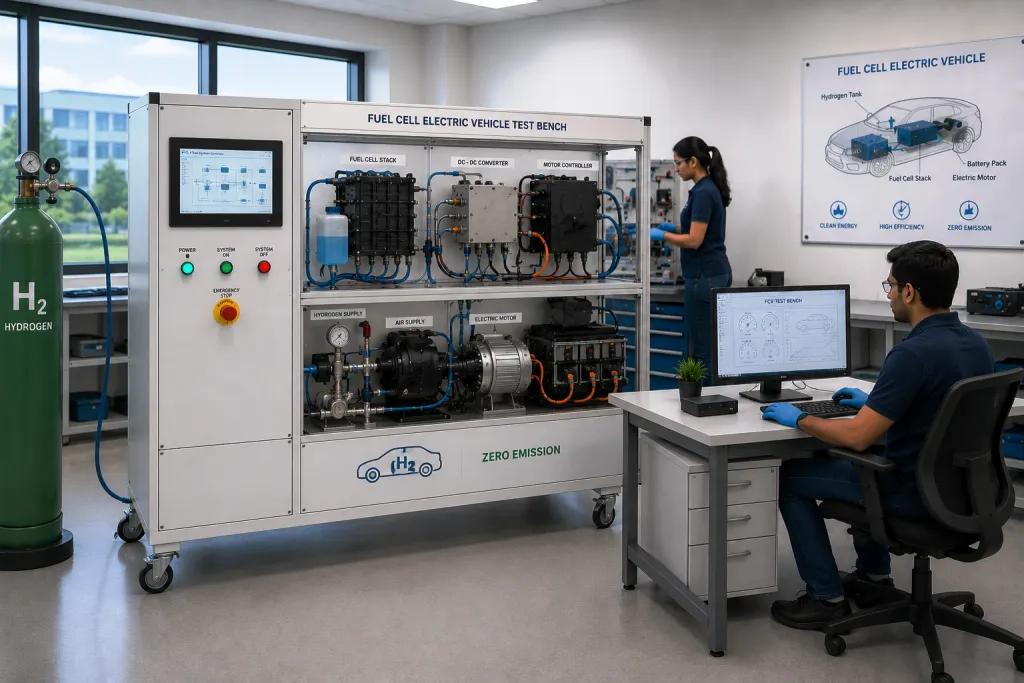
The Fuel Cell Electric Vehicle Learning System is a comprehensive 48V test bench that replicates the complete drivetrain of a fuel cell hybrid vehicle. A 2500W closed-cathode PEM fuel cell supplies power through a boost converter to a 48V DC link. The DC link connects a 48V / 75Ah lithium-ion battery bank and a 165F ultracapacitor via bidirectional converters, and drives a 2.5kW PMSM traction motor coupled to a PMSM loading motor and resistive load bank. A LabVIEW-based software platform with STM32 microcontroller provides three operating modes, vehicle dynamics simulation and real-time data logging — making this the most complete fuel cell EV research platform available for university labs.

Fuel Cell Electric Vehicle Learning System

Specifications

Fuel Cell TypeAir cooled PEM
Fuel Cell Power3000 W
Fuel Cell H₂ Pressure0.55–0.75 bar
Fuel Cell H₂ Purity>99.995% dry H₂
Fuel Cell H₂ Consumption≤0.78 Nm³/kWh at max load
Ambient Temperature−10°C to +45°C
DC Link Voltage48V
Battery Bank48V, 75Ah, Lithium-ion (LFP)
Ultracapacitor48V, 165 Farad
PMSM Traction Motor48V, 2.5kW, 3000 RPM
PMSM Motor Controller48V, 60A
PMSM Loading Motor48V, 2.5kW, 3000 RPM
Resistive Load Bank2.5 kW

What this system does

The Fuel Cell Electric Vehicle Learning System brings the architecture of a real fuel cell hybrid vehicle onto a compact, safe, lab-scale test bench. The 2500W closed-cathode PEM fuel cell stack supplies hydrogen from a high-pressure cylinder at 0.55–0.75 bar and generates DC power at 43.2–57.6V. A boost converter raises and regulates this output to a stable 48V DC link. The battery bank and ultracapacitor connect to the DC link through independent bidirectional IGBT converters, replicating the energy management architecture of a production fuel cell vehicle — fuel cell for steady-state power, battery for transient demand, ultracapacitor for peak power and regenerative braking capture. The DC link feeds a three-phase PMSM motor controller driving a 2.5kW PMSM traction motor. The traction motor is mechanically coupled to a PMSM loading motor acting as a generator, whose AC output is rectified and dissipated through a 2.5kW resistive load bank — simulating road load.

What's included

3000W PEM fuel cell stack with controller and SMPS
Hydrogen supply system — cylinder, pressure regulator, rotameter, H₂ supply valve and purge valve
48V / 75Ah lithium-ion (LFP) battery bank
165F / 48V ultracapacitor
2.5kW PMSM traction motor with 48V / 60A motor controller
2.5kW PMSM loading motor (generator)
Sensor boards — fuel cell, battery bank, ultracapacitor, three-phase motor (voltage and current)
Desktop PC / laptop interface
Illustrated experiment manual and wiring documentation
On-site installation, commissioning and faculty training

Experiments this system enables

PEM fuel cell V-I characterisation at different load conditions
Fuel cell power output variation with hydrogen supply flow rate
DC link voltage regulation through boost converter under varying load
Battery State of Charge monitoring during fuel cell charging and load discharge
Ultracapacitor charge and discharge characteristics during transient load steps
Energy management between fuel cell, battery and ultracapacitor — steady state and transient
PMSM traction motor speed-torque characterisation
Vehicle dynamics analysis — drag force, rolling resistance, motor torque and tank-to-wheel efficiency
Custom speed profile execution using table and simulated mode
MPPT and custom control algorithm testing using STM32 microcontroller

Technical features

Complete hybrid drivetrain architecture

Fuel cell, battery and ultracapacitor connected through independent power converters to a common DC link — identical to the architecture of production fuel cell vehicles

Vehicle dynamics simulation

Full vehicle model — mass, aerodynamic drag coefficient, rolling resistance, gear ratio, road gradient, wheel torque and tank-to-wheel efficiency — computable from the LabVIEW interface

Individual sensor boards

Dedicated voltage and current sensor boards for fuel cell, battery, ultracapacitor and three-phase motor — all parameters visible in real time without external instruments

PEM fuel cell

3kW Air cooled open cathode PEM Fuel Cell
Applications

University fuel cell EV and hybrid drivetrain research labsPower electronics — DC-DC converter, bidirectional converter and motor drive researchEnergy management strategy development and testingPostgraduate and doctoral research in fuel cell vehicles and power electronicsFCEV research

Frequently asked questions

Ready to build your hydrogen lab?
Our team will prepare a detailed proposal for your institution within 48 hours.