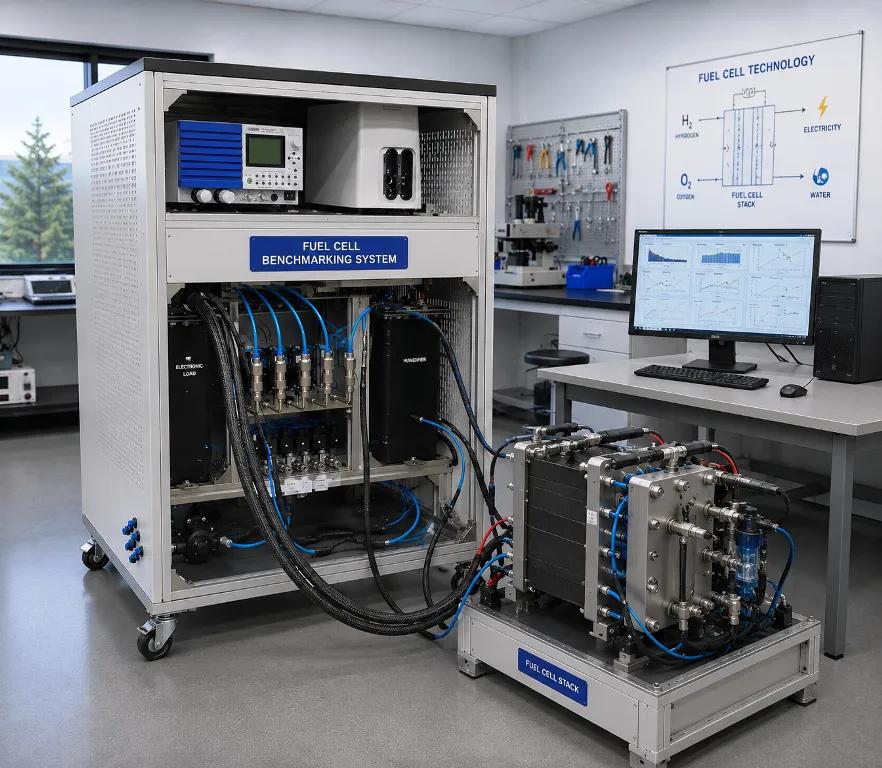
What this system does
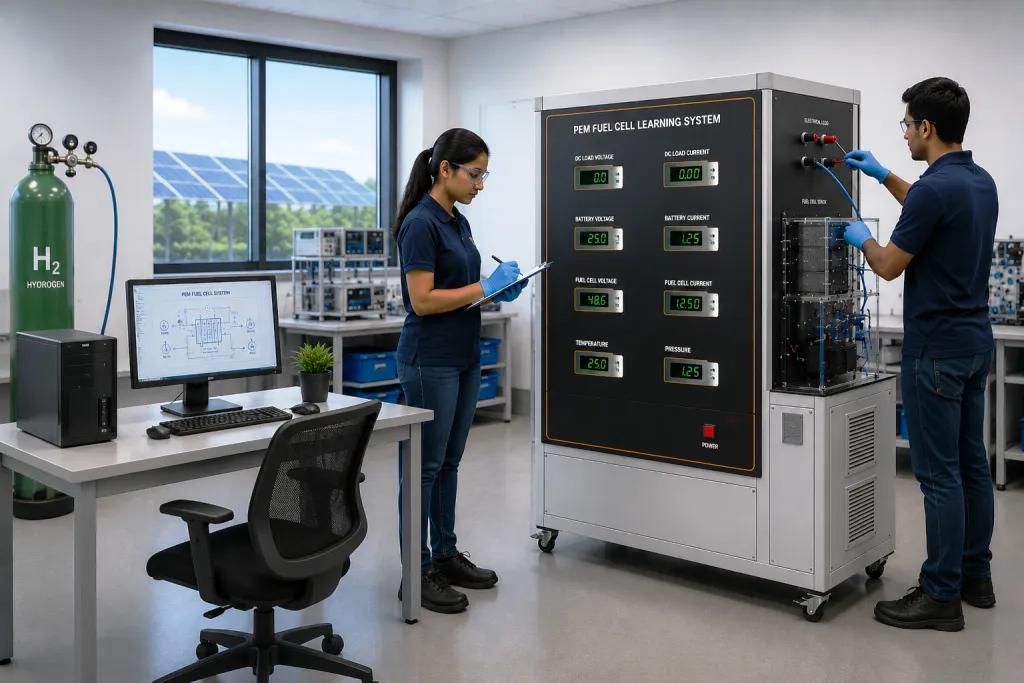
The Fuel Cell Benchmarking System gives researchers and engineers a structured, automated environment for fuel cell performance evaluation. The system accepts user-supplied PEM fuel cell stacks in its modular mounting fixture and connects them through a standardised interface panel and stack protection system. Hydrogen is delivered at controlled flow rate and pressure via a mass flow controller and pressure regulation assembly with integrated safety. Air is supplied through a controlled delivery unit with flow meter and optional humidity control. The programmable DC electronic load applies constant current, constant voltage or dynamic load profiles — including automated load cycling — while the measurement system simultaneously logs fuel cell voltage, individual cell voltages, current, hydrogen and air flow rates, temperature and pressure. The real-time monitoring software provides automated test sequencing, performance analysis and data logging. Researchers can generate complete polarisation curves, power curves and efficiency maps across operating conditions, compare multiple stacks against a consistent protocol, study degradation over time and investigate the effect of temperature, pressure, humidity and stoichiometry on stack performance — all from a single integrated platform.
What's included
Experiments this system enables
Technical features
User-selectable stack compatibility
Modular mounting fixture accepts different PEM stack sizes and configurations — researchers can benchmark their own stacks or commercially available units
Programmable electronic load
CC, CV and dynamic load profile modes allow polarisation curves, load cycling, transient response and custom protocol execution without manual adjustment
Individual cell voltage monitoring
Cell-by-cell voltage measurement identifies non-uniform performance, membrane degradation and flooding — not available on basic fuel cell trainers
Mass flow control
Precise hydrogen and air flow control enables accurate stoichiometry studies and hydrogen utilisation efficiency measurement
Automated test sequencing
Tests can be programmed and run automatically — consistent protocol execution across experiments, operators and sessions
Optional humidity control
Air humidity can be controlled independently to study its effect on membrane hydration, proton conductivity and fuel cell performance