Quick Definition
Electrochemical Impedance Spectroscopy (EIS) is a non-destructive electrochemical diagnostic technique that measures how a fuel cell responds to a small alternating current (AC) signal across a range of frequencies. It helps evaluate charge transfer, membrane resistance, mass transport, and degradation mechanisms, making it an essential tool for fuel cell testing, performance optimization, and health monitoring.
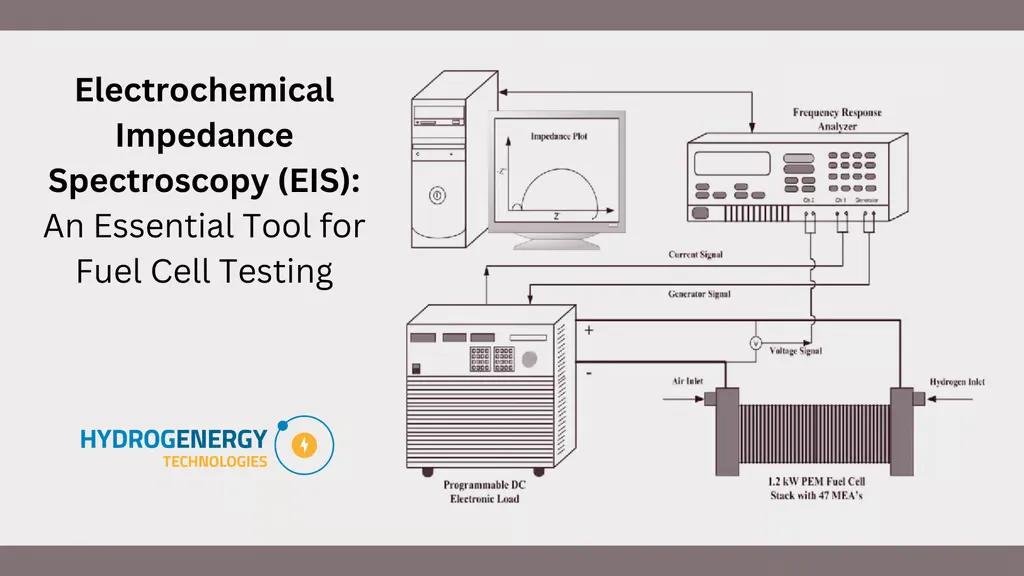
Electrochemical Impedance Spectroscopy is a powerful and versatile technique used to analyze and characterize electrochemical systems. It's especially valuable in the study and testing of fuel cells, which convert chemical energy into electrical energy through electrochemical reactions. This article covers what EIS is, how it works, where it fits in a fuel cell testing workflow, and its advantages and disadvantages.
What is Electrochemical Impedance Spectroscopy (EIS)?
EIS measures the impedance of an electrochemical system across a range of frequencies. Impedance, analogous to resistance in DC circuits, is a measure of how much a system resists the flow of an alternating current. In an electrochemical context, impedance is shaped by factors such as charge transfer resistance, diffusion, and the double-layer capacitance at the electrode-electrolyte interface.
How does EIS work?
EIS involves applying a small AC voltage or current to the fuel cell and measuring the resulting response. This is repeated across a range of frequencies to build an impedance spectrum, typically plotted as a Nyquist plot (imaginary versus real impedance) or a Bode plot (impedance magnitude and phase versus frequency).
Fuel cell EIS measurements commonly sweep from around 10 kHz down to somewhere between 0.1 Hz and 0.01 Hz, using a small perturbation, often in the range of 5 to 10 mV, to keep the system operating in its linear response region. Going below this amplitude window risks a noisy signal, while going above it risks disturbing the fuel cell's actual operating state and skewing the result.
The impedance spectrum is then fitted to an equivalent circuit model representing the cell's underlying electrochemical processes. This fitting identifies and quantifies parameters such as charge transfer resistance (tied to reaction kinetics), double-layer capacitance (charge storage at the electrode-electrolyte interface), and Warburg impedance (linked to diffusion-limited processes within the cell).
Why is EIS used to test fuel cells?
Fuel cells are complex electrochemical systems with multiple interacting components and processes running at once. EIS is used because it offers a non-destructive, highly sensitive way to separate and analyze those processes individually. The main reasons it gets used in fuel cell testing:
- Characterization of electrochemical processes: EIS can differentiate between charge transfer, mass transport, and adsorption or desorption processes, giving a detailed picture of how the cell is actually operating.
- Diagnosis of performance issues: analyzing the impedance spectrum helps identify problems like catalyst degradation, membrane conductivity losses, and electrode flooding, often before they show up clearly in a simple polarization curve.
- Optimization of fuel cell design: EIS shows how individual components contribute to overall performance, which helps guide material and design choices during development.
- Monitoring degradation and lifespan: repeated EIS measurements over time can track how a cell's internal resistance and capacitance shift as it ages, supporting predictive maintenance and lifespan estimates.
EIS versus other fuel cell diagnostic techniques
EIS is rarely used in isolation. Most fuel cell test protocols pair it with other measurement techniques, each suited to a different part of the picture.
| Technique | What it measures | Best for | Limitation |
|---|---|---|---|
| EIS | Impedance across a frequency range, separating internal processes | Diagnosing which specific process (charge transfer, diffusion, membrane resistance) is limiting performance | Requires expertise to interpret, and steady-state conditions during the sweep |
| Polarization curve (I-V) | Voltage output across a range of current densities | Overall performance benchmarking, comparing cells or stacks | Doesn't separate out individual loss mechanisms |
| Cyclic voltammetry (CV) | Current response to a swept voltage | Catalyst surface area, electrochemical activity | Less suited to characterizing a fully assembled, operating fuel cell |
This is also where EIS connects directly to test station setup. Since it depends on stable operating conditions during the frequency sweep, the quality of an EIS measurement is tied to the load control, temperature regulation, and humidity control built into the fuel cell test station running it, which is why EIS capability is typically specified as a feature of the test station itself rather than treated as a separate standalone instrument.
Advantages of EIS
- Non-destructive: EIS doesn't damage the fuel cell during testing, so the same cell can be measured repeatedly over its life.
- High sensitivity: it can detect subtle changes in electrochemical processes that other techniques miss.
- Comprehensive: a single EIS sweep provides information on multiple internal processes at once, rather than requiring separate tests for each one.
Disadvantages of EIS
- Complex data interpretation: reading EIS data well requires expertise, particularly for multi-component systems like fuel cells where several processes overlap in the frequency spectrum.
- Specialized equipment: running EIS requires a potentiostat or frequency response analyzer capable of the measurement, along with fitting software, both of which add cost and a learning curve.
- Time: sweeping across a full frequency range, especially down into the low-frequency end, takes longer than a quick polarization curve, which can be a constraint in fast production testing environments.
Conclusion
Electrochemical Impedance Spectroscopy remains one of the most useful diagnostic tools in fuel cell research and testing, precisely because it separates out the individual electrochemical processes that a simple voltage-current measurement can't distinguish. It takes more expertise and equipment than a basic polarization test, but the detail it provides on catalyst condition, membrane health, and mass transport losses is difficult to get any other way. For labs setting up EIS capability as part of a broader testing workflow, it's worth checking that a fuel cell test station's load control and environmental stability are matched to what a clean EIS sweep actually requires, since the measurement is only as good as the conditions it's taken under.
Need help with your hydrogen project?
Our engineers respond within 24 hours with a recommendation.

Hydrogenergy Applications Engineering Team
Applications Engineering · Hydrogenergy Technologies
Hydrogenergy's applications engineering team designs and supplies hydrogen systems for research labs and industry across India — from components to complete commissioned setups.