Quick Definition
Hydrogen vs. battery storage compares two essential energy storage technologies shaping the clean energy transition. Batteries provide high-efficiency, short-duration electricity storage, whereas hydrogen enables large-scale, long-duration energy storage with greater energy density. This makes both technologies complementary rather than direct competitors.
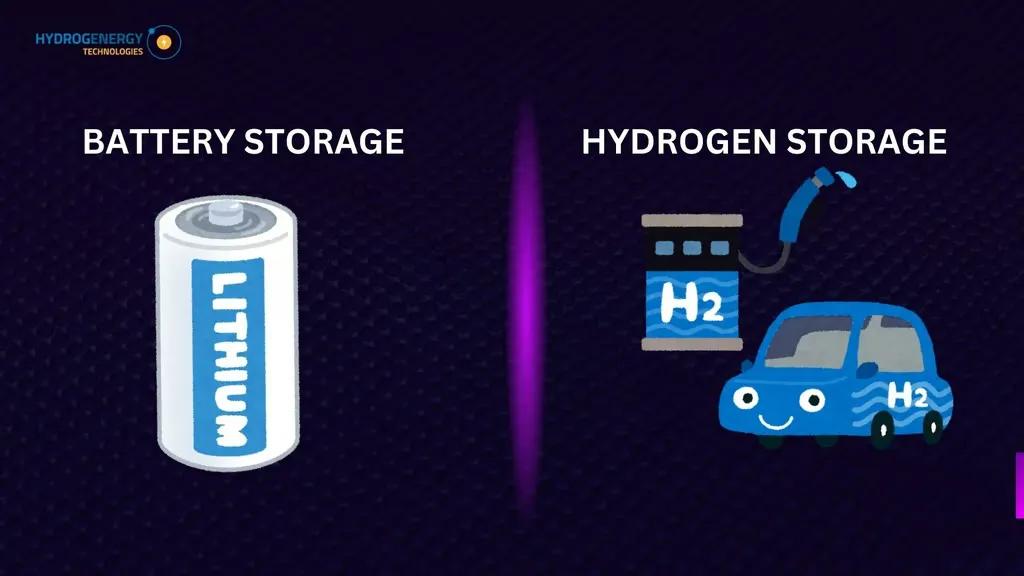
Hydrogen vs. Battery Storage: Which is the Future of Energy?
As the world grapples with the challenges of climate change, the search for sustainable energy solutions has never been more urgent. Two of the most promising technologies in this quest are hydrogen fuel cells and battery storage. Both offer pathways to a cleaner, more sustainable energy future, but which one will lead the way? In this article, we explore the key differences between hydrogen fuel cells and battery storage, weighing their advantages and challenges to determine which technology is best suited for the energy needs of tomorrow.
Overview of Hydrogen Fuel Cells
Hydrogen fuel cells operate on a simple yet powerful principle: they convert hydrogen gas into electricity through an electrochemical reaction. In this process, hydrogen molecules are split into protons and electrons. The electrons flow through an external circuit, creating an electric current, while the protons move through an electrolyte to combine with oxygen from the air, producing water and heat as byproducts. This reaction generates electricity with zero emissions, making hydrogen fuel cells an attractive option for a range of applications.
Key benefits include zero emissions, since hydrogen fuel cells produce only water vapor as a byproduct, making them an environmentally friendly energy source. They also have high energy density. Hydrogen has a higher energy density than batteries by weight, meaning it can store more energy per unit of mass, making it ideal for applications requiring long-range or heavy-duty power, such as trucks, buses, and industrial machinery. Scalability is another strength, since hydrogen fuel cells can be scaled up for large power plants or down for smaller devices, offering flexibility across various sectors.
Challenges remain, however. Production and storage of hydrogen, especially green hydrogen through electrolysis, is energy-intensive and currently expensive. Storing hydrogen safely and efficiently also presents significant challenges. Infrastructure needs are substantial too. Adoption requires extensive infrastructure, including hydrogen production facilities, storage systems, and refueling stations, which are still in their early stages of development. Cost and efficiency are also concerns. Although costs are decreasing, hydrogen fuel cells are still more expensive than batteries in many applications, and current technologies have room for improvement in efficiency.
Overview of Battery Storage
Batteries store energy chemically and convert it into electricity when needed. In a typical battery, such as a lithium-ion battery, an electric current is created when ions move between the anode and cathode through an electrolyte during discharging and charging cycles. This technology is well understood, widely used, and continues to evolve rapidly.
Key benefits include availability and affordability. Battery storage systems, particularly lithium-ion batteries, have become increasingly available and affordable, thanks to mass production and technological advancements. They also offer high efficiency, with minimal energy loss during storage and conversion, and are capable of delivering power almost instantaneously, making them ideal for applications requiring quick response times. An established infrastructure supports them too, since batteries are used in everything from consumer electronics to electric vehicles and grid storage.
Challenges include limited energy density. Compared to hydrogen, batteries have a lower energy density by weight, which limits their range and power output in applications like long-haul transportation. Degradation over time is also a factor, since batteries degrade with repeated charge cycles, leading to reduced capacity and eventually requiring replacement. Environmental impact is a concern too. The production of batteries, particularly the extraction of raw materials like lithium and cobalt, has significant environmental and social impacts, including mining-related pollution and human rights concerns.
Comparative Analysis
On energy density: hydrogen has a higher energy density than batteries by weight, making it more suitable for applications that require storing large amounts of energy in a compact mass. This is why hydrogen is often considered for heavy-duty transportation and industrial uses where weight constraints are critical, even though hydrogen's volumetric energy density is actually lower than batteries unless compressed or liquefied.
On efficiency, it's worth separating two different numbers that often get blurred together. A hydrogen fuel cell's own conversion efficiency, turning hydrogen back into electricity, typically runs around 40 to 60 percent. But the metric that actually matters for a storage comparison is round-trip efficiency: the percentage of electricity you get back after the full cycle of electrolysis, storage, and reconversion through a fuel cell. That round-trip figure for hydrogen systems is considerably lower, typically 30 to 40 percent, because each step in the chain (electrolysis, compression or liquefaction, and fuel cell conversion) loses energy. Lithium-ion batteries, by comparison, achieve round-trip efficiencies of roughly 85 to 95 percent, since there's no multi-stage energy conversion involved.
On environmental impact: while both technologies are cleaner than fossil fuels, their environmental impacts differ. Hydrogen fuel cells produce only water as a byproduct, but the environmental benefits depend on how the hydrogen is produced. Green hydrogen, produced via electrolysis using renewable energy, is the most sustainable, but current production methods often rely on natural gas, resulting in carbon emissions. Batteries, on the other hand, have a direct environmental impact related to the mining of materials and the eventual disposal or recycling of spent batteries.
On cost: batteries currently have a cost advantage due to economies of scale and advances in technology. The cost of lithium-ion batteries has dropped significantly over the past decade, making them the preferred choice for many applications. Hydrogen fuel cells, while becoming more competitive, remain more expensive due to the costs associated with hydrogen production, storage, and infrastructure development.
On use cases: hydrogen fuel cells are well-suited for applications where long-duration storage and heavy-duty power are needed, such as in heavy transport (trucks, buses, ships), industrial processes, and seasonal or grid-scale storage. Batteries, with their high round-trip efficiency and quick response times, excel in applications like personal electronics, short-range electric vehicles, and short-to-medium duration grid storage for balancing renewable energy sources.
Hydrogen vs. Battery Storage: Key Metrics
Hydrogen vs. Battery Storage: Key Metrics
| Metric | Hydrogen | Lithium-ion Battery |
|---|---|---|
| Round-trip efficiency | 30-40% | 85-95% |
| Energy density (by weight) | Higher | Lower |
| Energy density (by volume, uncompressed) | Lower | Higher |
| Response time | Slower | Near-instant |
| Best suited duration | Long-duration, seasonal storage | Short to medium duration |
| Infrastructure maturity | Early stage, developing | Established, widely deployed |
| Typical use cases | Heavy transport, industrial processes, grid-scale seasonal storage | Consumer electronics, EVs, short-duration grid balancing |
Future Outlook
Both technologies are rapidly evolving. For hydrogen fuel cells, ongoing research aims to lower production costs, improve storage methods, and increase overall efficiency. Solid-state batteries, which promise higher energy density and better safety, are seen as the next big leap in battery technology. These advancements will be crucial in determining the future viability and competitiveness of each technology.
Governments and industries are investing heavily in both hydrogen and battery technologies. The European Union, Japan, and South Korea have set ambitious hydrogen strategies, while the United States and China are leading the charge in battery production and EV adoption. These investments are likely to shape the energy landscape in the coming decades.
Rather than seeing hydrogen fuel cells and battery storage as competing technologies, there is growing recognition that they can complement each other. Batteries might be used for short-term storage and quick energy delivery, while hydrogen could be deployed for long-term storage and heavy-duty applications. Together, they can provide a robust, flexible, and sustainable energy system.
Conclusion
The debate between hydrogen fuel cells and battery storage is not about choosing one over the other but understanding where each technology excels. Hydrogen fuel cells, with their high energy density by weight and suitability for long-duration storage, are poised to play a significant role in sectors like transportation and heavy industry. Batteries, with their high round-trip efficiency and established infrastructure, will continue to dominate in consumer electronics, electric vehicles, and short-duration grid storage.
As technological advancements continue and infrastructure develops, both hydrogen and batteries will be crucial in the transition to a sustainable energy future. The key is not to pit these technologies against each other but to leverage their strengths in a complementary way, ensuring that we can meet the diverse energy needs of tomorrow's world.
Need help with your hydrogen project?
Our engineers respond within 24 hours with a recommendation.
Hydrogenergy Applications Engineering Team
Applications Engineering · Hydrogenergy Technologies
Hydrogenergy's applications engineering team designs and supplies hydrogen systems for research labs and industry across India — from components to complete commissioned setups.