Quick Definition
Artificial Intelligence (AI) in hydrogen refers to the use of data-driven algorithms and machine learning to improve every stage of the hydrogen value chain—from production and storage to transportation, safety monitoring, and fuel cell operation. By continuously analyzing real-time data, AI enables hydrogen systems to become more efficient, reliable, and economically viable.
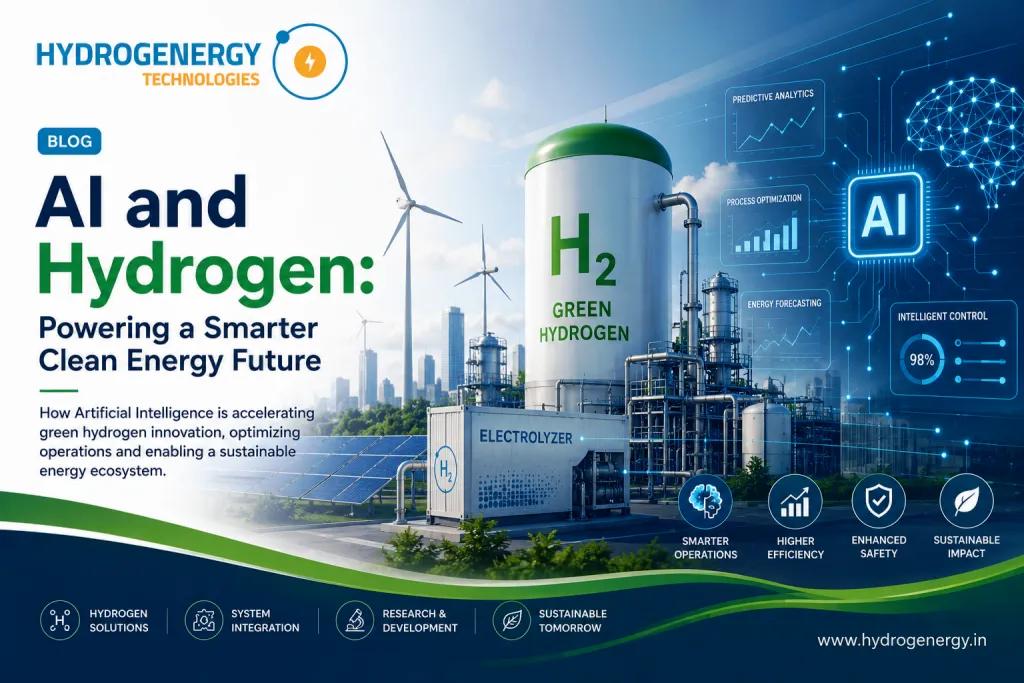
As the world moves toward a zero-carbon future, hydrogen is emerging as a powerful tool for decarbonizing the energy sector. However, integrating hydrogen into existing energy grids poses real challenges around efficiency, scalability, and real-time management. Artificial Intelligence is increasingly being applied to address exactly these challenges, and by 2026 the technology has moved from a purely theoretical pairing into genuine, deployed applications across production, safety monitoring, and grid integration.
The Hydrogen Economy: Promise and Challenges
Hydrogen is often called the "fuel of the future," with applications ranging from fuel cells in vehicles to large-scale energy storage for renewable grids. When used in a fuel cell, its only byproduct is water, making it a genuinely clean energy carrier.
Despite this promise, several challenges remain. Production inefficiencies persist, since electrolysis powered by renewable energy is still not as cost-effective as it needs to be for mass adoption. Storage and distribution remain difficult given hydrogen's low energy density and high flammability, requiring sophisticated infrastructure. Grid integration is complex too, since balancing hydrogen with other energy sources while maintaining real-time grid stability is a genuinely hard operational problem.
AI is increasingly being applied directly to these three challenges.
How AI Can Transform Hydrogen Energy
Optimizing Hydrogen Production
Electrolysis, the process of using electricity to split water into hydrogen and oxygen, is energy-intensive, and AI can optimize this in several ways. Predictive models can forecast periods of excess renewable generation from solar or wind, directing that energy toward electrolysis when it's most efficient. Real-time monitoring lets algorithms make minute adjustments to voltage, temperature and other operating parameters to increase efficiency. Machine learning can also identify recurring inefficiency patterns in the production process, continuously improving the workflow over time.
Enhancing Storage and Distribution
Hydrogen storage spans compressed gas, liquid hydrogen, and chemical carriers such as ammonia, each with distinct tradeoffs depending on the application. AI can help select the most appropriate storage method in real time based on cost, demand and infrastructure availability, drive more accurate leak detection than traditional sensor methods, and optimize distribution routes by accounting for traffic patterns, fuel costs and storage constraints.
Smart Grid Integration
Integrating hydrogen into the broader energy grid is one of the sector's biggest hurdles, and AI plays a genuine role here. Energy forecasting algorithms predict demand and supply fluctuations, helping balance hydrogen production against grid demand, feeding stored hydrogen back during low-renewable periods to maintain stability. Dynamic load balancing helps manage energy flows across solar, wind and hydrogen sources in real time, while automated decision-making reduces human error and speeds up grid operators' response to changing conditions.
Predictive Maintenance
Hydrogen infrastructure, whether production plants, storage facilities or distribution networks, requires regular maintenance to avoid downtime. AI-powered sensors can continuously monitor equipment health, machine learning models can predict component failures based on historical data before they become costly, and maintenance can be scheduled during low-demand periods to avoid disrupting operations.
Real-World Applications
Hydrogen Utopia International and BPODash (MENA region) offer a genuine, current example: Hydrogen Utopia International, which converts non-recyclable mixed waste plastic into hydrogen and other carbon-free fuels, partnered with US-based AI technology company BPODash to integrate AI-powered monitoring and predictive analytics across its waste-to-hydrogen facilities in the Middle East and North Africa. The partnership is intended to improve real-time operational oversight and predictive decision-making across the company's plants, a concrete example of AI directly supporting hydrogen production economics rather than a purely theoretical application.
More broadly across the industry, AI-driven predictive maintenance and leak detection are increasingly standard features in modern hydrogen production and storage facilities, following the same pattern our own customers apply when integrating leak detection systems and monitoring instrumentation into their hydrogen infrastructure, whether or not that monitoring layer is explicitly branded as "AI."
The Road Ahead
As the world moves toward a hydrogen-powered future, AI's role will continue to grow, particularly in production optimization, predictive safety monitoring, and grid-scale integration. The genuine constraint isn't whether AI can help; it clearly can. It's how quickly hydrogen producers integrate AI-driven monitoring and optimization into infrastructure that, in many cases, is still being built out for the first time.
Conclusion
The combination of AI and hydrogen represents a genuine, increasingly deployed opportunity for the energy sector, not merely a theoretical one. Real examples like Hydrogen Utopia's AI-driven monitoring partnership demonstrate that this pairing is delivering operational value today, even as full grid-scale AI integration remains a longer-term goal. As hydrogen infrastructure continues to expand, the sensor and monitoring layer generating the data AI depends on will matter just as much as the algorithms themselves.
Need help with your hydrogen project?
Our engineers respond within 24 hours with a recommendation.
Hydrogenergy Applications Engineering Team
Applications Engineering · Hydrogenergy Technologies
Hydrogenergy's applications engineering team designs and supplies hydrogen systems for research labs and industry across India — from components to complete commissioned setups.