Quick Definition
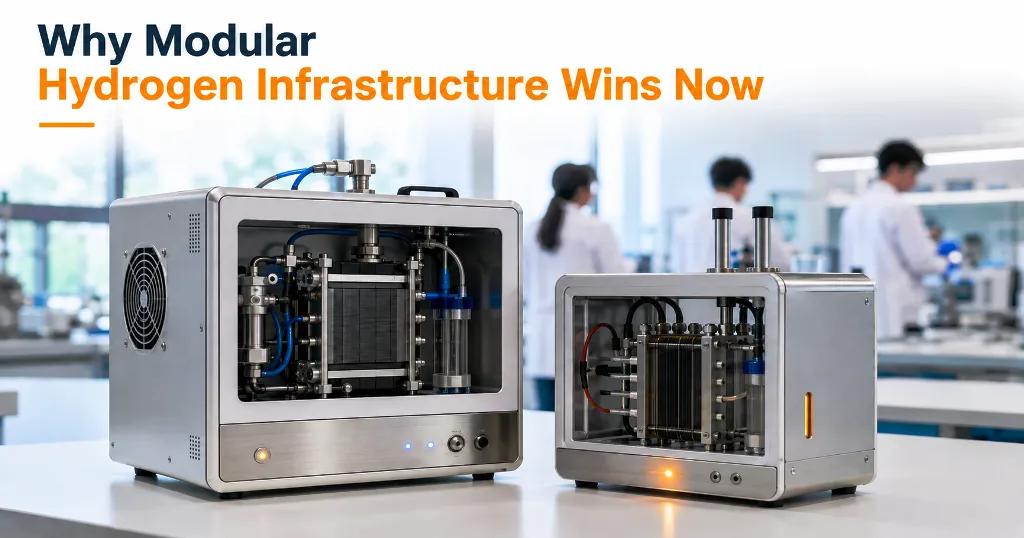
Modular hydrogen infrastructure refers to smaller-scale, standardized production, storage and testing equipment that can be deployed quickly for research, pilot projects and industrial trials, as opposed to large, centralized mega-projects requiring years of planning, financing and construction before producing a single kilogram of hydrogen.
India's National Green Hydrogen Mission set an ambitious target: 5 million tonnes of annual green hydrogen production by 2030. Three years in, the honest picture is more complicated than the headlines suggest, and understanding why is genuinely useful for anyone deciding how to move forward with a hydrogen project today, rather than waiting for the broader ecosystem to catch up.
The Mega-Project Bottleneck
As of August 2025, India had 158 green hydrogen projects at various stages of development, but roughly 94% of that planned capacity remained stuck at the announcement stage, not under construction, not commissioned, just announced. As of February 2026, actual commissioned production capacity stood at around 8,000 tonnes per year, a small fraction of the 5 million tonne target.
This isn't unique to India, and it isn't a sign the technology doesn't work. It's a predictable pattern for large, centralized infrastructure projects anywhere: financing takes time, offtake agreements need to be locked in before construction starts, and regulatory clarity on things like tradeable green-molecule certificates is still being worked out. A Parliamentary reply in August 2026 confirmed that only around ₹292 crore of the Mission's full ₹19,744 crore outlay had actually been spent so far, a useful, honest data point for understanding the real pace of large-scale deployment.
What's Actually Slowing Things Down
Companies awarded manufacturing support under the first electrolyzer tender round were required to commission their factories by August 2026. Several have reportedly asked for timeline extensions, citing a genuine practical problem: the manufacturing capacity was approved before the demand side (actual purchase orders for the hydrogen or electrolyzers themselves) had caught up. Building a factory is one thing; having confirmed buyers lined up for its output is another, and mega-scale projects are particularly exposed to this timing mismatch since so much capital is committed upfront before revenue starts flowing.
None of this reflects a problem with the underlying technology. Electrolyzers work. Fuel cells work. The bottleneck is specifically in financing, offtake certainty, and regulatory infrastructure catching up to match the scale of the largest announced projects.
Where the Real Progress Is Happening
It's worth being clear that genuine, commissioned progress does exist, it's just concentrated differently than the mega-project headlines suggest. JSW Energy commissioned India's largest green hydrogen manufacturing plant at its Vijayanagar facility in Karnataka in November 2025, directly supplying JSW Steel under a seven-year agreement for 3,800 metric tonnes annually, with plans to expand to 90,000 tonnes by 2030. This is exactly the kind of project that succeeds: a committed offtake partner (JSW Steel itself) locked in before the plant was built, rather than production capacity built speculatively ahead of demand.
That's the pattern worth paying attention to: projects succeed fastest when they start with confirmed, specific demand rather than waiting for a fully mature national ecosystem to materialize first.
The Case for Starting Smaller
For universities, research institutions, and industrial teams evaluating their own hydrogen work, the mega-project delays are actually a useful signal, not a reason to wait. The same financing and offtake bottlenecks that slow multi-hundred-crore production plants simply don't apply to lab-scale and pilot-scale equipment.
A university building out a hydrogen and fuel cell learning lab doesn't need a seven-year offtake agreement or Mission-level financing, it needs equipment that works reliably and ships on a reasonable timeline. A researcher testing a new fuel cell design doesn't need to wait for national electrolyzer manufacturing capacity to hit 15 GW, they need a test station that's available now. An industrial team piloting hydrogen use in a specific process doesn't need to match JSW's scale on day one, they need the right electrolyzer and supporting instrumentation sized to their actual pilot, not to a 2030 national target.
This is precisely the gap modular, component-level infrastructure fills while the larger ecosystem works through its financing and regulatory maturation. Waiting for mega-projects to de-risk the sector before starting smaller-scale work means losing years of hands-on experience, data, and institutional capability that could be building right now.
Conclusion
The gap between India's green hydrogen ambitions and its current commissioned capacity is real, and being honest about it is more useful than pretending otherwise. But that gap exists almost entirely at the mega-project, national-scale level, driven by financing timelines and offtake certainty that any large infrastructure sector faces. It says very little about whether now is a good time to start smaller, whether that's a university building a teaching lab, a research team piloting a new fuel cell design, or an industrial facility testing hydrogen in a specific process. If anything, the sector's current growing pains make hands-on, modular infrastructure more valuable, not less, since real experience built today puts you ahead of the curve once the broader ecosystem catches up.
Need help with your hydrogen project?
Our engineers respond within 24 hours with a recommendation.
Hydrogenergy Applications Engineering Team
Applications Engineering · Hydrogenergy Technologies
Hydrogenergy's applications engineering team designs and supplies hydrogen systems for research labs and industry across India — from components to complete commissioned setups.