Quick Definition
The "Saptadhara," or seven streams, is a national development framework announced by Prime Minister Narendra Modi during India's 80th Independence Day address on August 15, 2026, outlining seven strategic pillars intended to drive India toward becoming a developed nation (Viksit Bharat) by 2047. Green hydrogen was explicitly named within the sixth stream, the Green and Blue Economy, alongside renewables, energy storage, and ocean resource development.
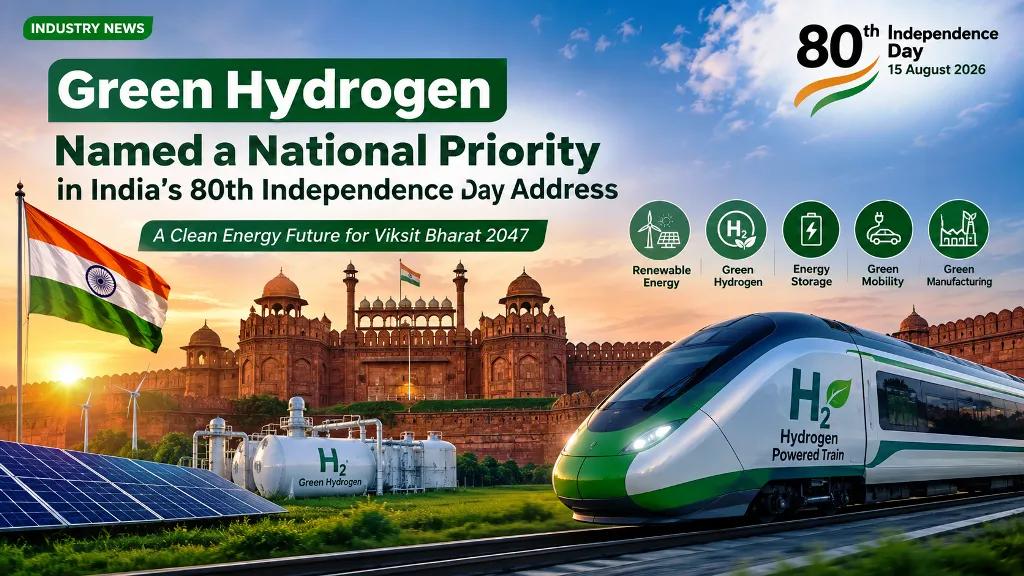
Every year, India's Independence Day address from the Red Fort sets the tone for national policy priorities for the year ahead. This year's address, marking 80 years of independence, did something genuinely notable for the hydrogen sector: it formally elevated green hydrogen from a standalone mission into one of seven core pillars of India's entire national development strategy through 2047.
Green Hydrogen's New Place in National Strategy
In his address, Prime Minister Modi introduced the Saptadhara framework, seven strategic streams intended to guide India's growth over the coming decades: Manufacturing Power, Agriculture and Food Processing, Technology and Innovation, Gati Shakti (infrastructure), Defence Shakti, the Green and Blue Economy, and Soft Power.
The sixth stream, the Green and Blue Economy, was explicitly framed around green hydrogen, renewable energy, energy storage, and marine resource development, positioning India as what the Prime Minister described as a proactive problem-solver on climate change rather than simply a participant in global discussions about it.
This matters for how green hydrogen gets funded, prioritized, and coordinated across ministries going forward. A standalone mission (the National Green Hydrogen Mission) competes for attention and budget on its own terms. A pillar within the government's central seven-stream national strategy carries a different kind of institutional weight, and tends to see more consistent cross-ministry coordination over time.
The Numbers Behind the Announcement
The address came with a genuine data-backed track record on the broader clean energy transition, not just aspirational language:
- Solar capacity grew from 2 GW in 2014 to 160 GW today, with a new target of 500 GW of total renewable capacity by 2030
- Nuclear energy capacity is targeted to reach 100 GW by 2047, with 5 new reactors becoming operational within 6-7 years
- City gas distribution expanded from roughly 70 cities to 700 cities over the past 12 years
- Piped cooking gas connections reached 1.75 crore households
- The PM Surya Ghar Muft Bijli Yojana (free rooftop solar scheme) has crossed 50 lakh households, with some families now earning income by selling surplus electricity back to the grid
These figures matter for hydrogen specifically because green hydrogen production is fundamentally downstream of renewable electricity capacity. A larger, more reliable renewable grid directly improves the economics of electrolysis at scale, so the solar and broader clean energy trajectory isn't a separate story from hydrogen's, it's the foundation it depends on.
A World-First Hydrogen Train
Among the more specific announcements, the Prime Minister confirmed that India has begun work on what's being described as the world's longest and most powerful hydrogen train, a genuinely notable claim for a technology still in relatively early commercial deployment globally. Hydrogen-powered rail is an area where a small number of countries (including Germany, which operates the world's first commercial hydrogen train fleet) have moved first, so a claim to build the longest and most powerful version specifically signals real ambition for India's hydrogen mobility applications beyond road transport.
What This Actually Means
It's worth being precise about what changed here and what didn't. The National Green Hydrogen Mission itself, its ₹19,744 crore outlay, its SIGHT scheme for electrolyzer manufacturing and green hydrogen production incentives, remains the primary funding and implementation vehicle. This address doesn't replace that mission or introduce new hydrogen-specific funding on its own.
What it does do is formally position green hydrogen within the government's highest-level strategic framing for the next two decades, alongside manufacturing, defence, technology, and infrastructure as core national priorities rather than a niche environmental initiative. For an industry that has, at times, had to make the case for its own strategic relevance, that's a meaningful shift in framing, even if the practical, on-the-ground funding and project execution challenges we've discussed elsewhere continue to require real, patient work to resolve.
Conclusion
Formally naming green hydrogen within one of seven national development pillars is a genuine, verifiable elevation in how the government frames the sector's strategic importance, backed by a real, data-supported track record on renewable energy growth over the past 12 years. It doesn't replace the practical work of scaling manufacturing, closing the gap between announced and commissioned capacity, or resolving the financing challenges facing individual projects, but it does suggest hydrogen is likely to remain a consistent national priority well into the 2030s, which is meaningful context for anyone building in this space today.
Need help with your hydrogen project?
Our engineers respond within 24 hours with a recommendation.
Hydrogenergy Applications Engineering Team
Applications Engineering · Hydrogenergy Technologies
Hydrogenergy's applications engineering team designs and supplies hydrogen systems for research labs and industry across India — from components to complete commissioned setups.