Quick Definition
The National Green Hydrogen Mission is India's national strategy to accelerate the development of a green hydrogen economy. Approved in 2023, the mission supports domestic electrolyzer manufacturing, green hydrogen production, infrastructure, research, and pilot projects with the objective of making India a global leader in green hydrogen by 2030.
Introduction: India's Climate Goals and Green Hydrogen
India has set ambitious climate goals, including achieving energy independence by 2047 and net-zero emissions by 2070. Green hydrogen, produced using renewable energy sources, is central to these objectives. It offers a versatile, sustainable energy carrier that can decarbonize sectors ranging from steel and ammonia production to heavy transport, reducing reliance on fossil fuels and supporting India's low-carbon transition. Launched in January 2023, the National Green Hydrogen Mission aims to build a robust domestic ecosystem covering production, electrolyzer manufacturing, infrastructure and export capability.
The Imperative for Green Hydrogen in India
India's energy consumption has roughly doubled over the past two decades and continues to grow. The country imports a substantial share of its primary energy at significant annual cost, with transportation and industrial production heavily dependent on imported fossil fuels. Green hydrogen, produced using India's abundant solar and wind resources, offers a pathway to reduce this dependency while supporting the broader energy transition.
Mission Objectives and Targets
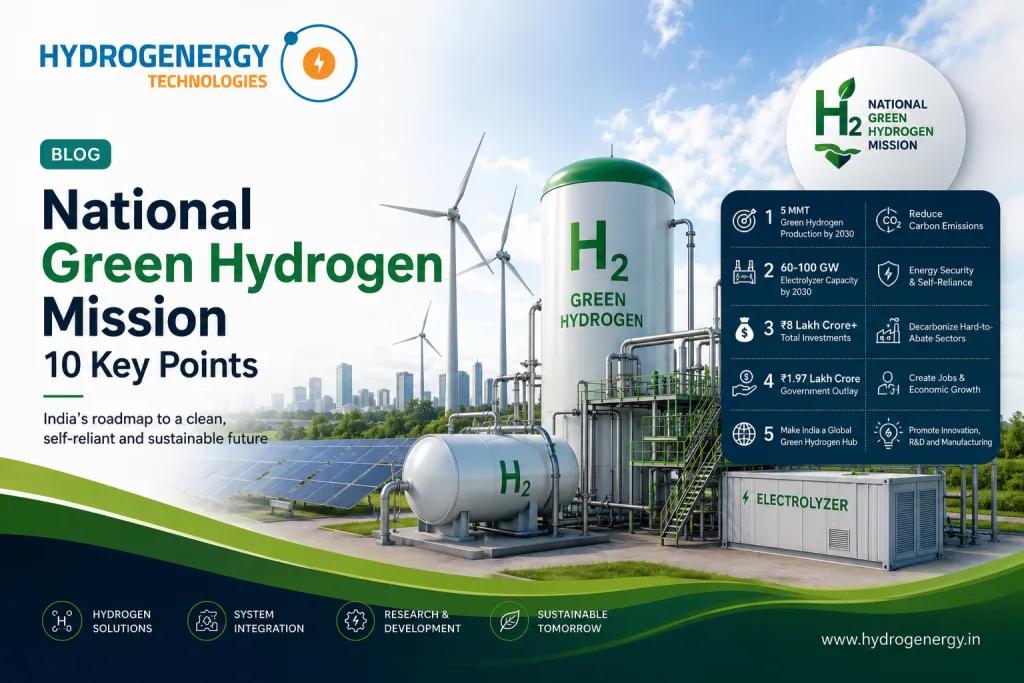
The Mission's core objective is positioning India as a global leader in green hydrogen production and export. It targets at least 5 million metric tonnes (MMT) of annual green hydrogen production by 2030, supported by an estimated 125 GW of dedicated renewable energy capacity. The Mission aims to attract roughly ₹8 lakh crore in investment, create around 6 lakh jobs, and cut carbon emissions by an estimated 50 million tonnes annually once fully realized.
Phased Approach to Deployment
The Mission uses a phased approach. Phase I (2022-2026) focuses on creating demand and enabling supply by scaling up domestic electrolyzer manufacturing capacity, targeting refineries, fertilizers and city gas sectors to build sustained demand. Phase II (2026-2030) aims to scale production as green hydrogen becomes more cost-competitive, extending into commercial-scale projects across steel, mobility and shipping.
Strategies for Green Hydrogen Production
India's strategy leverages its renewable energy cost advantage, its growing domestic electrolyzer manufacturing base (spanning technologies from : alkaline to PEM electrolyzers), and decentralized production models using rooftop solar, small hydro and biomass to minimize transport requirements.
Infrastructure Development and Risk Management
The Mission supports infrastructure for hydrogen storage, transport and utilization, including port facilities for exporting derivatives, pipeline development for bulk transport, and collaborative hydrogen hubs linking producers and consumers. It also addresses regulatory and supply chain risk to help stabilize the emerging ecosystem.
Collaborative Governance Framework
Implementation spans multiple government agencies. The Ministry of New and Renewable Energy (MNRE) leads overall coordination, with the Ministry of Power supporting renewable energy delivery, the Ministry of Petroleum and Natural Gas driving adoption in refineries and city gas distribution, the Ministry of Chemicals and Fertilizers promoting green ammonia-based fertilizers, and the Ministry of Road Transport and Highways supporting adoption in heavy commercial vehicles.
Financial and Technological Support
The Mission's total approved outlay is ₹19,744 crore, split across the SIGHT (Strategic Interventions for Green Hydrogen Transition) programme at ₹17,490 crore, pilot projects at ₹1,466 crore, R&D at ₹400 crore, and other components at ₹388 crore. Within SIGHT, ₹4,440 crore is earmarked for electrolyzer manufacturing incentives and ₹13,050 crore for green hydrogen production incentives. A separate ₹100 crore startup support fund backs green hydrogen innovation specifically.
Progress as of 2026
As of May 2025, 19 companies held SIGHT allocations totalling 862,000 tonnes per year of green hydrogen production capacity, and 15 firms had been awarded a combined 3,000 MW per year of electrolyzer manufacturing capacity. In the second SIGHT allocation round, L&T Energy, AM Green Ammonia, Green Infra Renewable Energy Farms and Waaree Clean Energy Solutions each secured 90,000 tonnes per year allocations.
On the demand side, contracts have been awarded for supplying green hydrogen to public-sector refineries including IOCL, BPCL, HPCL and NRL, alongside agreements to supply roughly 6.7 lakh tonnes per year of green ammonia to 11 fertiliser plants. Competitive bidding under SIGHT has discovered green ammonia prices between ₹49.75 and ₹64.74 per kg, well below the global benchmark of roughly ₹110 per kg, a genuinely encouraging signal on cost competitiveness.
Six states have now notified dedicated Green Hydrogen Policies, with seven more incorporating hydrogen provisions into existing frameworks. In June 2026, the Ministry launched the Green Hydrogen Certification Portal of India (GHCI), establishing a national mechanism for verifying green hydrogen production credentials, a foundational requirement given that export viability and investor confidence depend on credible, verifiable green certification. JSW commissioned a 3,600 tonnes-per-year green hydrogen production plant in November 2025, a concrete sign of policy intent translating into operational reality.
A fair reading of the progress also requires acknowledging where the Mission is behind expectations. As of February 2026, India had commissioned only around 8,000 tonnes per year of actual green hydrogen production capacity, a small fraction of the 5 MMT annual target for 2030. Independent analysis published in mid-2026 has also noted a structural gap between "awarded" SIGHT capacity and capacity that's actually been commissioned and is operating, since SIGHT incentives reward awarded allocations rather than verified delivery, and no penalty mechanism for missed commercial dates has been publicly disclosed. Of the Mission's full outlay, only a modest portion had been disbursed roughly three years in. None of this undermines the Mission's fundamentals, but it's a more honest picture than early-stage press coverage alone would suggest.
Key Metrics
- Total Mission outlay: ₹19,744 crore
- 2030 production target: 5 MMT of green hydrogen annually
- Supporting renewable capacity target: ~125 GW
- Projected investment attracted: ~₹8 lakh crore
- Projected jobs created: ~6 lakh
- Projected annual emissions reduction: ~50 million tonnes
- SIGHT allocations awarded (as of May 2025): 862,000 TPA green hydrogen production; 3,000 MW/year electrolyzer manufacturing
- Green hydrogen commissioned (as of Feb 2026): ~8,000 TPA
- Green ammonia price discovered via SIGHT bidding: ₹49.75 to ₹64.74/kg (vs. ~₹110/kg global benchmark)
- Green hydrogen production cost in India (2026): ₹397 to ₹560/kg, versus grey hydrogen at ₹150 to ₹200/kg
- States with dedicated Green Hydrogen Policies: 6 (plus 7 more with partial hydrogen provisions)
Need help with your hydrogen project?
Our engineers respond within 24 hours with a recommendation.
Hydrogenergy Applications Engineering Team
Applications Engineering · Hydrogenergy Technologies
Hydrogenergy's applications engineering team designs and supplies hydrogen systems for research labs and industry across India — from components to complete commissioned setups.