H₂ Products

All Products
Electrolyzers
Fuel Cells
H₂ Leak Detectors
Dew Point Meters
Hydrogen Purity Analyzers
Mass Flow Controllers
Digital Pressure Gauges
MEA & Materials

Can't find what you need? We source custom components.

Custom Request →
MEMS Mass Flow Controllers
Productsmass flow controllersMEMS Mass Flow Controllers

MEMS Mass Flow Controllers

Fast Response · Compact · Low Power

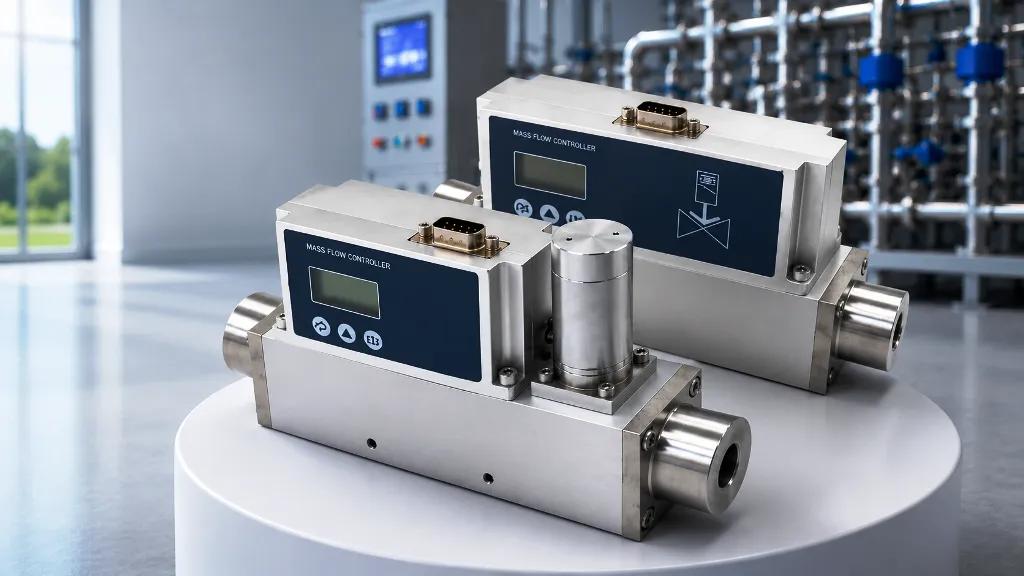
MEMS-based mass flow controllers for precise hydrogen and gas flow regulation. Microelectromechanical sensing technology delivers fast response, compact form factor and low power consumption — suited for fuel cell test benches, electrolyzer systems and analytical instrumentation.

Products

HMFC-S0MEMS Mass Flow

MEMS mass flow controller, 1–100 SCCM range. ±1.0% setpoint accuracy, RS485 Modbus RTU, 4-20mA output, compatible with hydrogen and inert gases.

Lead time: 4–6 weeks

Specifications
Flow Range1–100 SCCM
Mechanical ConnectionG1/4 or PT1/2 internal thread
Sensing TechnologyMEMS thermal flow sensor with bypass laminar flow design
Control Accuracy±1.0% of setpoint
Measurement Accuracy1% F.S. (≤50 L/min) / 1.5% F.S. (>50 L/min)
Range Ratio1:100
Valve TypeNormally closed electromagnetic proportional valve
Power SupplyDC 24V / 6W
Operating Temperature-10 to 55°C
Operating Humidity<95% RH, non-condensing
Output Signal4-20mA / 1-5V (0-5V or 0-10V customizable)
CommunicationRS485, Modbus RTU protocol
Control Response Time<1.5s (T90)
Response Time<50ms
Protection RatingIP40
Gas CompatibilityAir, N₂, O₂, CH₄, Ar, CO₂, He, H₂, C₃H₈
DisplayLCD — instantaneous flow, cumulative flow, setpoint

What is a MEMS Mass Flow Controller?

A MEMS mass flow controller uses microelectromechanical systems (MEMS) sensing technology to measure and control gas flow rate. A microfabricated thermal sensor chip — built using semiconductor manufacturing techniques — measures the mass flow of gas passing through a bypass channel with extremely fast response and high precision, at a fraction of the size and power consumption of conventional thermal mass flow sensors.

The MEMS sensor chip contains heating and temperature-sensing elements patterned directly onto a silicon substrate. As gas flows across the chip, heat transfer between the upstream and downstream sensing elements changes in proportion to the mass flow rate — this signal is processed and used to drive an integrated control valve, maintaining the flow at the user-defined setpoint through continuous closed-loop feedback.

MEMS technology offers several advantages over traditional mass flow controller designs: faster response time due to the low thermal mass of the sensor chip, lower power consumption suited to portable and battery-operated instruments, smaller physical footprint enabling denser instrument panel layouts, and improved long-term stability due to the inherent precision of semiconductor fabrication. MEMS mass flow controllers are increasingly the preferred choice for fuel cell test stands, electrolyzer gas supply control, and any application where precise, repeatable, fast-responding flow control is required in a compact package. Hydrogenergy supplies MEMS mass flow controllers across a range of flow capacities for hydrogen and other process gas applications.

Applications

Fuel cell test bench gas supply control
Electrolyzer hydrogen and water flow regulation
Analytical instrument carrier gas control
Gas blending and mixing systems
Compact multi-channel test station integration
Portable and field-deployable gas control instruments

Frequently asked questions

What is the advantage of MEMS technology over conventional thermal mass flow sensors?
MEMS sensors are fabricated using semiconductor manufacturing techniques, resulting in a much smaller and lighter sensing element than conventional wire-wound thermal sensors. This translates into faster response time — often under one second — lower power consumption, a more compact instrument footprint, and improved manufacturing consistency across units. For applications requiring rapid flow changes or compact multi-channel installations, MEMS-based controllers offer clear practical advantages.
What gases can a MEMS mass flow controller be used with?
MEMS mass flow controllers can be configured for hydrogen, nitrogen, oxygen, argon, air and many other process gases, typically through a gas-specific calibration or correction factor applied at the factory or in the field via digital configuration. Confirm the specific gas and concentration range when ordering to ensure correct calibration for your application.
What flow ranges are available?
MEMS mass flow controllers are available across a wide range of full-scale flow rates, from sub-sccm precision instruments for analytical applications up to several hundred standard litres per minute for larger test station and process applications. For best accuracy, select a unit where your typical operating flow falls between 10% and 100% of the full-scale range.
What interface options are available?
MEMS mass flow controllers in this range are available with analogue interfaces (0-5V, 4-20mA) and digital communication options (RS-485, Modbus) depending on the model. Digital interfaces support multi-channel installations on a shared communications bus, simplifying wiring in multi-gas test stations.
How accurate are MEMS mass flow controllers?
MEMS-based controllers typically achieve accuracy within ±1% of full scale or better, with repeatability often within ±0.2% — comparable to or exceeding conventional thermal mass flow technology. Combined with fast response time, this makes MEMS controllers well suited to dynamic test applications such as fuel cell load cycling and transient flow studies.
Need help choosing the right model?
Our engineers will recommend the right mems mass flow controllers for your application.
Talk to an Engineer →